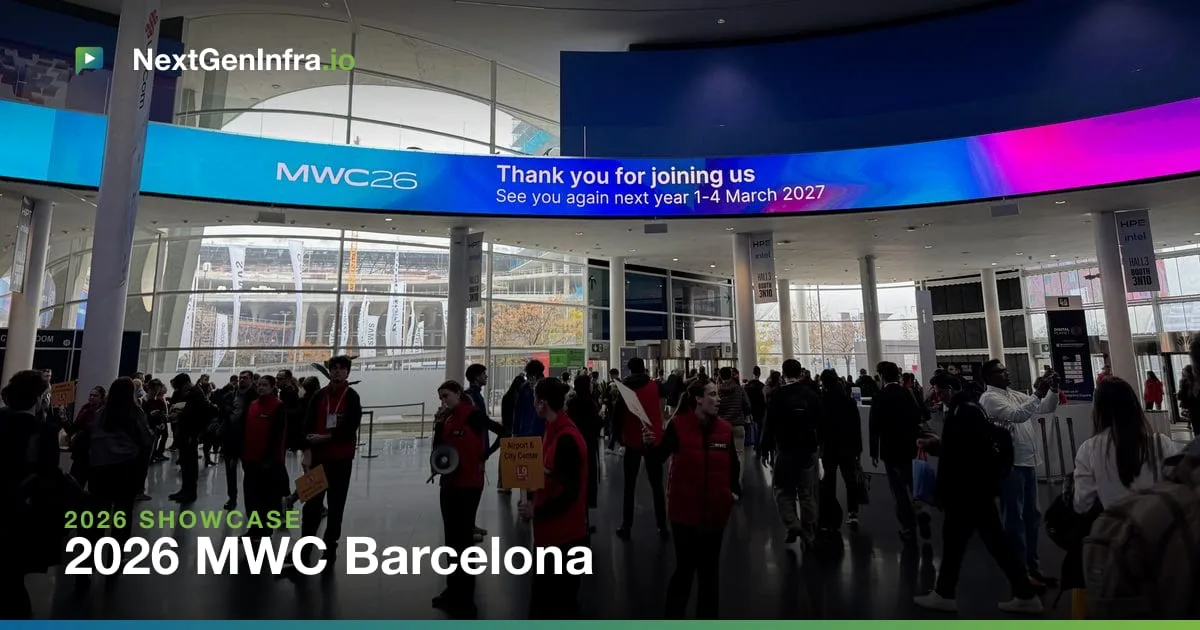
2026 MWC Barcelona
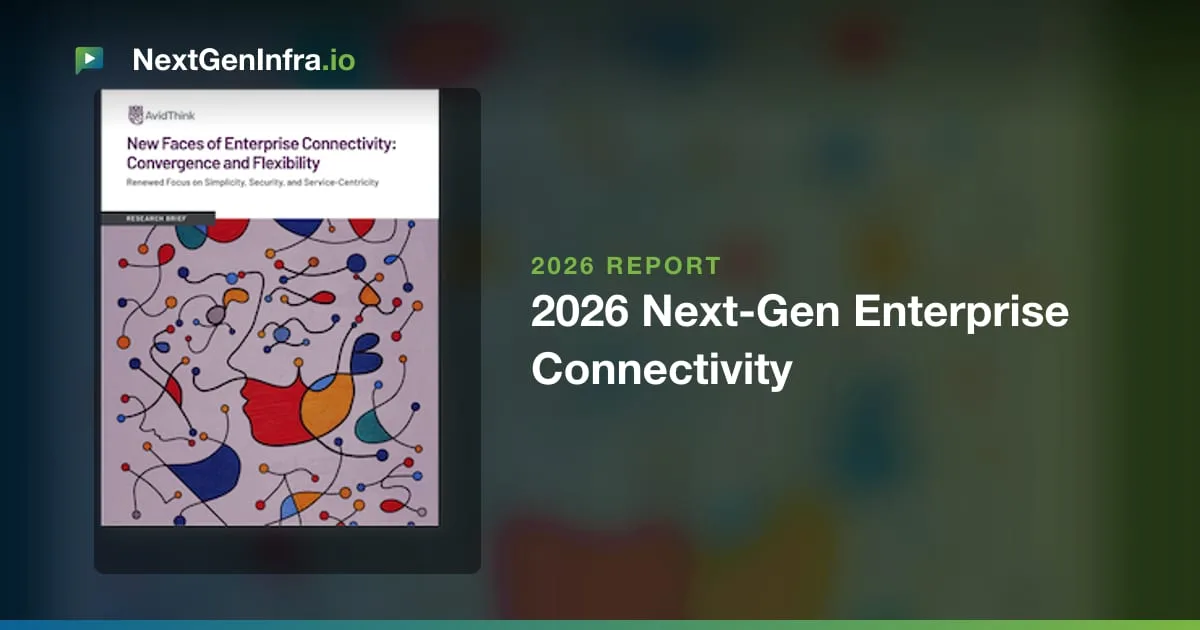
Meanwhile, as you patiently await the full complement of videos from the show, download a copy of our latest 2026 NextGen Enterprise Connectivity report, which covers the convergence of enterprise networking and security, and touches on the state of SASE, SD-WAN, ZTNA, and Campus NaaS. You know, the "hot" value-add services that run on top of our wireless, wired, and non-terrestrial networks.
Video Reels from MWC Barcelona - the AI show
Reader feedback on New Faces of Enterprise Connectivity Report: “very comprehensive,” “covers cutting-edge trends in the enterprise networking market,” “insightful.” Grab your copy now!
Human Highlights from MWC Barcelona
Views expressed are those of the presenting individuals and companies and may not necessarily represent views of Converge! Network Digest or AvidThink.
AI Inference Network Fabric: Low Latency Solutions for Service Providers
Sanjay Kumar, VP of Products and Marketing at Arrcus, announces the Arrcus inference network fabric at MWC 2026, a solution enabling network operators to deliver agentic and physical AI with low latency, data sovereignty, and reduced cost per inference. He reveals a partnership with Fujitsu combining Fujitsu’s Monaka processor with Arrcus’ programmable operating system and Oneinity’s optical interconnect, along with customer announcements with Lightstorm, demonstrating Arrcus’ capabilities across edge 5G, multicloud networking, and data centers.
Building Service Provider Networks for the AI Era
Gurudatt Shenoy, Senior Vice President of Data Center and Provider Connectivity at Cisco Systems, discusses how AI requires service provider networks that can manage high traffic volumes, performance-sensitive workloads, and secure traffic within sovereign boundaries. He explains that Cisco addresses these requirements through its new Cisco Silicon 1 technology and routing infrastructure systems specifically designed for AI-era demands.
Building AI-Ready Networks for the Service Providers
Sandro Tavares, Director, Telecom Systems Marketing at Dell, discusses the foundational elements required for the AI era in service provider networks, including high-volume traffic handling, performance and latency-sensitive capabilities, and secure infrastructure. He highlights Cisco’s new Silicon 1 technology and routing portfolio designed to meet these AI era demands.
AI Powered Network Automation
Dudy Cohen, VP of Product Marketing at DriveNets, presents the company’s dual AI strategy at MWC 2026, introducing automation tools that simplify service provider operations and enable autonomous networks while helping operators leverage existing infrastructure for new AI business opportunities. DriveNets enables service providers to use the same infrastructure for both legacy services and new offerings like GPU-as-a-service, allowing them to build GPU clusters, become neo-clouds, and capitalize on the AI market.
GSMA Launches Open Telco AI
Louis Powell, AI Initiatives, Engagement & Technical Lead at GSMA, announces the Open Telco AI initiative at MWC Barcelona 2025, a collaborative effort with AT&T and Deutsche Telekom to develop “telco grade AI” that addresses current limitations in understanding telecommunications standards and performing deployable root cause analysis at scale. The initiative focuses on benchmarking performance metrics, building appropriate datasets, and training specialized models through a community-driven approach featuring competitions, hackathons, and code sharing, inviting operators, vendors, academics, researchers, and startups to join at gsma.com/opentelcoai.
Distributed AI Workloads Reshape Network Infrastructure
Julius Francis, Senior Director, Product Marketing at HPE, explains how AI workloads are becoming distributed across multiple sites beyond traditional data centers, requiring robust networking infrastructure, and how HPE’s integration with Juniper combines compute, storage, networking, and security capabilities including cloud-native routing in ProLiant servers for edge environments. He highlights opportunities for telecommunications providers to leverage their infrastructure for distributed AI interconnection and announces the SPX 12000 router, delivering over 500 terabytes per second in 32RU with 800 Gig capability and 1.6T readiness, featuring deep buffers, low latency, and line-rate security for hyperscalers, telcos, and cloud-scale enterprises.
The New Open Centralized Unit Distributed Unit (OCUDU) Effort
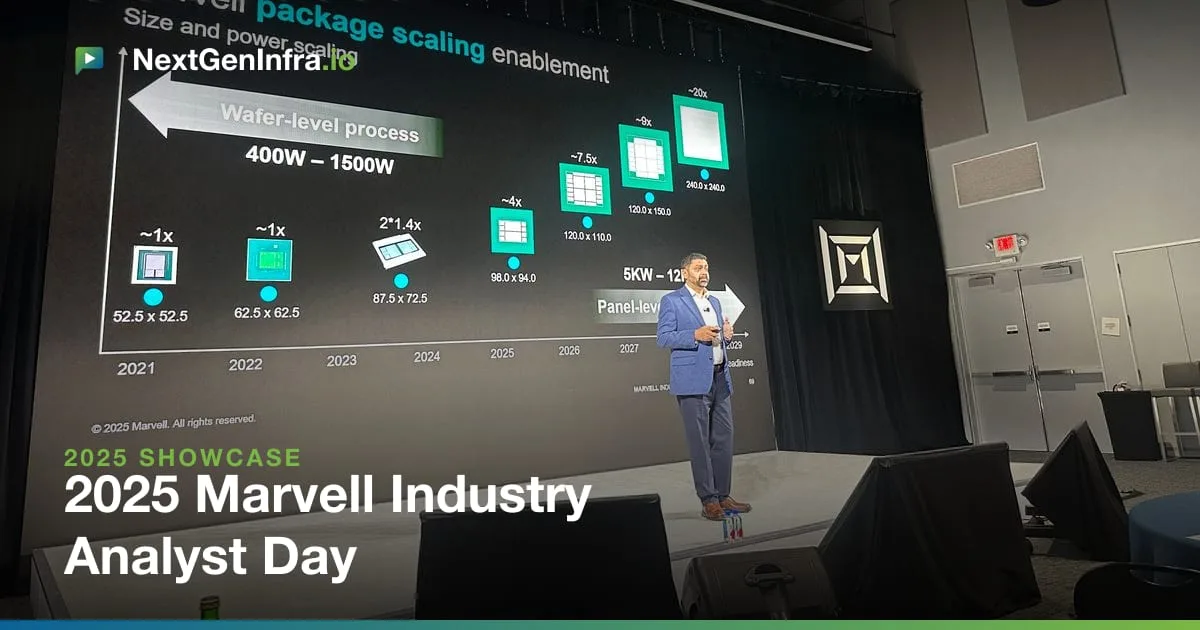
Joel Brand, AVP, Product Marketing at Marvell, explains how major wireless vendors are shifting to software differentiation while adopting standardized CPUs and GPUs, creating opportunities for harmonization through initiatives like the Linux Foundation’s OCUDu and OCP projects. He highlights that Marvell is uniquely positioned as the only provider of macro-grade merchant silicon to address the industry’s economic challenges by moving from custom silicon to market-optimized solutions that offer better cost efficiency and power performance at scale.
Nokia's 800G Pluggables for AI Data Center Networks
Jon Baldry from Nokia presents the company’s 800 gig pluggable optical connectivity solutions for data center interconnection at Mobile World Congress, demonstrating through augmented reality how the technology reduces power consumption by 65-70% compared to embedded optics—a critical advantage for power-constrained data center operators managing AI-driven traffic between core and edge facilities. Nokia maintains its competitive edge in the 800 gig ZR and ZR plus optics market through vertical integration, manufacturing pluggables, subsystems, and optical chips at its indium phosphide fabrication facility in California, enabling superior transmission distances and supply chain control.
Network Visibility Across Domains
Robert Shore, Head of Optical Network Marketing at Nokia, discusses how Nokia’s comprehensive end-to-end view of network connectivity—spanning mobile networks, core networks, submarine networks, and data center interconnect—provides valuable perspective for developing optical networking solutions. Shore explains that understanding what happens in the RAN and access networks enables Nokia to build better optical solutions that can accommodate the types of traffic flowing between the RAN and data centers, ultimately delivering a more holistic network solution for customers.
Physical AI in Action
Houman Modarres, Head of Enterprise Marketing at Nokia, presents the company’s physical AI initiative at Mobile World Congress, showcasing Surf food delivery trucks with Nvidia Jetson GPUs deployed across seven US cities in partnership with DoorDash and Uber Eats. Nokia is collaborating with Nvidia and T-Mobile to build an “AI grid” that distributes processing across devices, AI RAN, and network layers, enabling applications like safe navigation, human assistance, and multilingual customer support through LLMs running on the radio network.
90% of Telcos See Revenue Gains from AI
Chris Penrose, Global Head Business Development – Telco at NVIDIA, presents findings from NVIDIA’s fourth annual AI report showing that 90% of telecom respondents report AI is already increasing revenues or reducing costs, with planned AI spending jumping from 65% in 2024 to 89% in 2025. Network transformation through AI has become the top use case, with 77% of respondents expecting to implement AI-native networks before 6G arrives, focusing on spectral efficiency, energy efficiency, performance improvements, and service personalization.
From Standardization to AI-Driven Consumption
Markus Kümmerle, Principal at MKWK Consulting, reports from Mobile World Congress Barcelona that the API ecosystem achieved 60 stable APIs in 2025 and is now shifting focus to customer value through channel partner products and aggregated API solutions. He explains that the industry must enable agentic AI and large language models to discover and call APIs through MCP servers, with CAMARA adapting its guidelines to support both product development and MCP server deployment for increased API consumption.