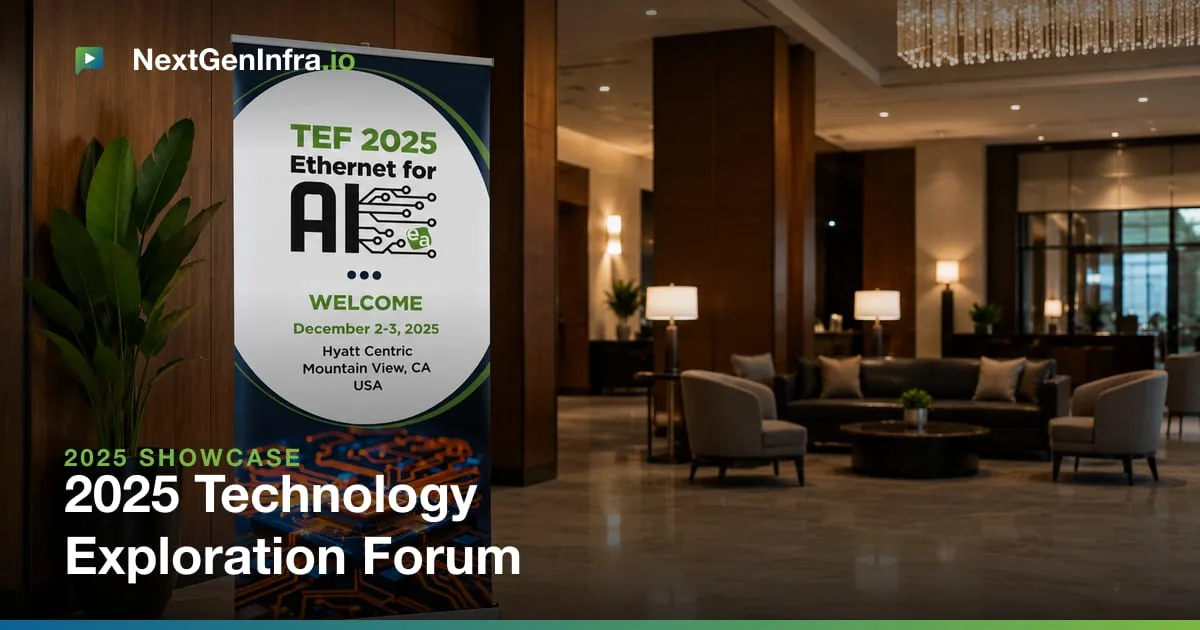
2025 Showcase
Technology Exploration Forum Showcase
The Ethernet Alliance held their Technology Exploration Forum (TEF) exploring Ethernet for AI in Mountain View, CA on December 2-3, 2025. The NextGenInfra.io team was on the ground to capture thought leader perspectives on changes and evolution needed in Ethernet to support AI/ML workloads — both on the front-end and back-end (scale out).
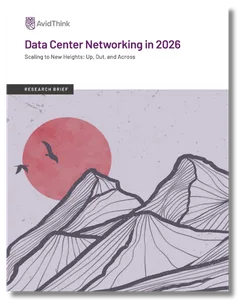
While you're here, feel free to grab our latest research brief right from this page.
Sponsor Spotlight 650 Group
Accelerating the Ethernet Market
Alan Weckel, Founder and Technology Analyst at 650 Group, presents from TEF 2025 on the $200 billion Ethernet switching market opportunity driven by AI infrastructure requiring multiple interconnected networks for GPUs and XPUs, with bandwidth growth accelerating from 30-40% to 70-80% CAGR. He projects data centers will exceed one billion ports within years, creating multi-billion dollar opportunities across LPO, LRO, ACC, AEC, and CPO transceiver technologies as the industry experiences 4x revenue increases alongside dramatic expansion in speeds and capacity.
Sponsor Spotlight Arista Networks
Power, Cooling & the Future of Data Center Design
Arihant Jain, Manager, Systems Engineering at Arista Networks, examines scale-out networking architectures and interconnect technologies while highlighting how power, cooling, and space constraints are increasingly driving data center network design decisions alongside traditional requirements. He emphasizes Ethernet's expanding role across scale-up and scale-out applications, anticipates 1.6 terabit deployments with hybrid cooling solutions by 2026, and identifies scale-across connectivity between geographically distributed data centers as a key deployment trend for the coming year.
Sponsor Spotlight Broadcom
Data Center Optimization Strategies
Pete Del Vecchio, Data Center Switch Product Line Manager at Broadcom, presents at the Technology Exploration Forum for Internet Alliance 2025, highlighting how the event uniquely brings together the entire AI infrastructure ecosystem to address the massive scale of modern data centers, with some reaching 5 gigawatts and multi-million GPU clusters. He emphasizes the comprehensive optimization approach being applied across all components, from nanometer-scale silicon transistors to racks, as the industry collaborates to enable next-generation AI infrastructure capable of supporting systems the size of Manhattan.
Sponsor Spotlight CCCA, IWCS
Ethernet for AI: Defining Infrastructure Standards
David B. Kiddoo, Executive Director / CEO of CCCA and IWCS, explains his organizations' sponsorship of the Ethernet Alliance conference that brings together decision makers from Meta, Microsoft, and Hewlett Packard to address Ethernet for AI and the convergence of power and data supporting AI and quantum computing infrastructure. The conference enables the interconnect and network infrastructure industry to learn directly from technology providers about required innovations, necessary codes and standards, and how to allocate limited resources effectively to advance AI and quantum computing technologies.
Sponsor Spotlight Cisco Systems
AI Infrastructure Demands Are Accelerating 400G Per Lane Ethernet
Ravi Shah, Director, Corporate Strategy at Cisco Systems, discusses how AI use cases are driving unprecedented infrastructure adoption as hyperscalers deploy XPUs and GPUs requiring proportional networking growth across scale-up, scale-out, and scale-across architectures. He explains the industry's focus on achieving 400 gigabit speeds through ecosystem collaboration addressing engineering challenges, while emphasizing the forum's role in enabling thought leaders to leverage open standards like Ethernet and advance AI infrastructure development.
Sponsor Spotlight Cisco Systems
Building Next-Gen Ethernet: Collaboration, Innovation & Industry Challenges
Adee Ran, Architect of Ethernet at Cisco Systems, discusses his standards work with IT and UltraEthernet, emphasizing the collaborative effort required across industries to develop next-generation networking technologies. He explains that achieving mature next-generation technology requires inventing numerous components, such as optical modules with doubled improvements in signal integrity, power consumption, cost, and manufacturing yield, though the timeline for these innovations remains uncertain.
Sponsor Spotlight Dell'Oro Group
Faster and Faster Networking Upgrade Cycles
Baron Fung, Senior Research Director at Dell'Oro Group, examines data center infrastructure markets with emphasis on servers and connectivity, tracking the evolution from current 112 gigabit SerDes supporting 400 gigabit ports to emerging 224 gigabit SerDes enabling 800 gigabit speeds for GPU platforms. He highlights that accelerator platforms now advance every 18 months or less, driving the ecosystem toward Ethernet-based solutions and the upcoming transition to 440 gigabit SerDes networks to support next-generation AI and accelerated computing requirements.
Sponsor Spotlight Ethernet Alliance
Why Betting Against Ethernet Fails: Meeting AI's Speed Demands
Peter Jones, Chair of the Ethernet Alliance and Cisco Systems employee, addresses the accelerating pace of Ethernet speed transitions at the second TF Ethernet for AI event, noting that 400 gigabit Ethernet is emerging before 200 gigabit is fully deployed. He emphasizes that the industry must focus on "just enough" rather than attempting everything at once, while highlighting Ethernet's consistent success over competing technologies.
Sponsor Spotlight Ethernet Alliance
Industry-Wide Collaboration as Ethernet Speeds Ahead
John D'Ambrosia, Chair, IEEE P802.3dj Task Force at the Ethernet Alliance, discusses the evolution of 400 Gbit per second signaling for Ethernet in AI applications, noting that the next upgrade requires collaboration from all stakeholders across the industry ecosystem. He explains that the Ethernet Alliance facilitates this industry-wide collaboration through TEF events and partnerships, recognizing that faster consensus-building among manufacturers, material providers, and component makers accelerates progress toward solutions.
Sponsor Spotlight Ethernet Alliance, EXFO
Network Interoperability: Hyperscalers and Ethernet Standards
David Rodgers, Sr. Business development manager- EXFO and President & Events chair - Ethernet Alliance, examines the bifurcated state of network interoperability, contrasting hyperscalers like AWS optimizing AI-focused ecosystems with Ethernet standards prioritizing cross-vendor interoperability for broader markets. He highlights the Ethernet Alliance's evolving roadmap, first released in 2015 and now updated quarterly online, which tracks industry technologies, speeds, and interface nomenclatures to guide the industry through rapid changes in Ethernet technology.
Sponsor Spotlight IEEE
Advanced Modulation, FEC & Next-Gen Fiber Tech
John D'Ambrosia, Chair, IEEE P802.3dj Task Force at IEEE, discusses the working group's progress on 400 Gbit per second Ethernet signaling, covering modulation schemes, forward error correction, channel characteristics, and various fiber options including hollow core and multi-core fiber. He announces an IEEE workshop in late February to examine fiber technologies, emphasizing the goal of effective information transmission across different channel types as high-speed Ethernet development continues to advance.
Sponsor Spotlight Keysight Technologies
448 Gig Ethernet: Deployment Challenges & Engineering Choices
John Calvin, Senior Strategic Planner at Keysight Technologies, presents from the 2025 Ethernet Alliance hosted TEF event in Mountain View, discussing 448 gig technology and deployment barriers driven by hyperscaler growth and data center demands. He addresses challenges including higher order modulation formats, next generation connectors, and channel considerations, noting that engineering choices for the next speed grade remain under discussion at the event.
Sponsor Spotlight Keysight Technologies
AI Networking at 1.6T & 3.2T: Performance vs Power Trade-offs
Hadrien Louchet, Product Planner at Keysight Technologies, presents at a technology exploration forum on AI networking's future, noting that while 1.6T Ethernet deployment has begun and hyperscalers are planning for 3.2T Ethernet, the industry must navigate critical trade-offs between performance, power efficiency, reliability, and supply chain security as 400G signaling advances from lab to product. Louchet explains that Keysight, as a test and measurement expert, works with customers to understand testing requirements at these speeds and prepares products to support large-scale deployment of next-generation AI networking infrastructure.
Sponsor Spotlight Mediatek
Overcoming 400G Technology Challenges
Jim Hsieh, Senior Technical Manager at Mediatek, presents on the critical need for industry-wide collaboration to advance 400G technology, emphasizing cooperation among connector manufacturers, cable vendors, silicon vendors, optical vendors, and system providers. He explains that 400G's challenging initial conditions require precise link training protocols, standardized error correction methodologies, and robust Ethernet standards to ensure interoperability and reliable connections across all industry participants.
Sponsor Spotlight Meta
Next-Gen Interconnect Standards for Hyperscalers
Halil Cirit, AI & HPC Systems and Services Architect at Meta, explains how hyperscalers serve as end customers driving next-generation interconnect standardization by articulating technology requirements early in the development process rather than relying on off-the-shelf solutions. He highlights the success of this collaborative initiative over the past year and encourages industry partners to join in developing optimized interconnect specifications that deliver performance advantages and meet custom design needs.
Sponsor Spotlight Multilane
Ethernet Scaling Challenges & Solutions
Hani Daou, Business Development Manager at Multilane, presents on behalf of the Ethernet Alliance at the Technology Exploration Forum, discussing how Ethernet remains the preferred choice for scale-up and scale-out AI applications amid unprecedented demand for network connectivity, semiconductors, and testing. He emphasizes the forum's role as a critical venue for identifying technologies that must integrate seamlessly to address interoperability challenges and meet the demanding requirements of cloud service providers and end users with their growing appetite for AI-based applications.
Sponsor Spotlight OIF
OIF's 448G Framework: AI Fabric Challenges & Standards
Nathan Tracy, President of the OIF and representative from TE Connectivity, announces the publication of OIF's 448 gigabit framework document at the Ethernet Alliance's TEF 2025, marking the first deliverable from the project launched in August 2024. The framework establishes a common industry language for addressing challenges at 448 gigabit per second data rates, including modulation selection, reach requirements, AI fabric reliability demands, and the integration of electrical and optical modulation approaches.
Sponsor Spotlight OIF
CEI-448G Framework: New Standards AI Interconnect Networks
Cathy Liu, SerDes Architect at OIF, presents the newly published CEI-448G framework, a collaborative achievement by OIF members across AI hyperscalers, system vendors, and component manufacturers that establishes common guidelines for next-generation AI interconnect networks. The framework serves as foundational work identifying future projects including CEI-448G XSR, VSR, and LR variants, while emphasizing the need for collaboration among standards bodies such as IEEE 802.3 Ethernet, OCP, SNIA, and UEC.
Sponsor Spotlight Synopsys
Ethernet at 400G per Lane: Standards & Challenges
Kent Lusted, Distinguished Architect at Synopsys, discusses next generation Ethernet for AI at TEF, highlighting his role as champion for an IEEE 802.3 project focused on 400 gig electrical and optical signaling for AI networks optimized for radix scale-out use cases. He emphasizes the need for collaboration among hyperscalers, standards organizations like OIF, UEC, and SNIA, and component suppliers to address three major challenges for 448 and 400 gig Ethernet: faster time to market, optimal use of available information and materials, and recognition of AI's impact on daily life through search, recommendations, pattern recognition, and infrastructure.
Sponsor Spotlight TE Connectivity
The Race to 400 Gig Ethernet
Ashika Pandankeril Shaji, Manager System Architect at TE Connectivity, discusses the rapid evolution of Ethernet technology to 400 Gig speeds driven by AI network bandwidth demands and the significant technical challenges this transition presents, including shrinking channel budgets and increased sensitivity to impairments. She highlights how TE Connectivity addresses these challenges through advanced modulation techniques and improved connector designs, while emphasizing the value of industry collaboration at the TIP conference to solve complex engineering problems shaping the future of Ethernet and AI networks.

Latest Research Brief
Download Our Latest Report
Data Center Networking in 2026 — Scaling to New Heights
More about this report →
No personal info needed to download
Download the Latest Report
By downloading this report, you agree to our Terms of Use and Privacy Policy.
Highlights from industry thought leaders













Video interviews
Accelerating the Ethernet Market
- AI infrastructure drives a $200 billion Ethernet switching market opportunity.
- Bandwidth growth is accelerating from 30-40% to 70-80% CAGR.
- Data centers projected to exceed one billion ports with 4x revenue growth across LPO, LRO, ACC, AEC, and CPO.
Abstract
Alan Weckel, Founder and Technology Analyst at 650 Group, presents from TEF 2025 on the $200 billion Ethernet switching market opportunity driven by AI infrastructure requiring multiple interconnected networks for GPUs and XPUs, with bandwidth growth accelerating from 30-40% to 70-80% CAGR. He projects data centers will exceed one billion ports within years, creating multi-billion dollar opportunities across LPO, LRO, ACC, AEC, and CPO transceiver technologies as the industry experiences 4x revenue increases alongside dramatic expansion in speeds and capacity.
Power, Cooling & the Future of Data Center Design
- Power, cooling, and space constraints increasingly drive data center network design.
- 1.6 terabit deployments with hybrid cooling anticipated by 2026.
- Scale-across connectivity between distributed data centers is a key trend for the coming year.
Abstract
Arihant Jain, Manager, Systems Engineering at Arista Networks, examines scale-out networking architectures and interconnect technologies while highlighting how power, cooling, and space constraints are increasingly driving data center network design decisions alongside traditional requirements. He emphasizes Ethernet's expanding role across scale-up and scale-out applications, anticipates 1.6 terabit deployments with hybrid cooling solutions by 2026, and identifies scale-across connectivity between geographically distributed data centers as a key deployment trend for the coming year.
Data Center Optimization Strategies
- Modern AI data centers are reaching 5 gigawatts and multi-million GPU clusters.
- Optimization spans every layer, from nanometer-scale silicon transistors to full racks.
- TEF convenes the entire AI infrastructure ecosystem to enable next-generation buildouts.
Abstract
Pete Del Vecchio, Data Center Switch Product Line Manager at Broadcom, presents at the Technology Exploration Forum for Internet Alliance 2025, highlighting how the event uniquely brings together the entire AI infrastructure ecosystem to address the massive scale of modern data centers, with some reaching 5 gigawatts and multi-million GPU clusters. He emphasizes the comprehensive optimization approach being applied across all components, from nanometer-scale silicon transistors to racks, as the industry collaborates to enable next-generation AI infrastructure capable of supporting systems the size of Manhattan.
Ethernet for AI: Defining Infrastructure Standards
- Ethernet Alliance conference convenes decision makers from Meta, Microsoft, and Hewlett Packard.
- Focus is on the convergence of power and data for AI and quantum computing infrastructure.
- Interconnect industry learns required innovations, codes, and standards directly from technology providers.
Abstract
David B. Kiddoo, Executive Director / CEO of CCCA and IWCS, explains his organizations' sponsorship of the Ethernet Alliance conference that brings together decision makers from Meta, Microsoft, and Hewlett Packard to address Ethernet for AI and the convergence of power and data supporting AI and quantum computing infrastructure. The conference enables the interconnect and network infrastructure industry to learn directly from technology providers about required innovations, necessary codes and standards, and how to allocate limited resources effectively to advance AI and quantum computing technologies.
AI Infrastructure Demands Are Accelerating 400G Per Lane Ethernet
- Hyperscaler XPU and GPU deployments require proportional networking growth across scale-up, scale-out, and scale-across.
- Industry is focused on achieving 400 gigabit speeds through ecosystem collaboration.
- Open standards like Ethernet are central to advancing AI infrastructure.
Abstract
Ravi Shah, Director, Corporate Strategy at Cisco Systems, discusses how AI use cases are driving unprecedented infrastructure adoption as hyperscalers deploy XPUs and GPUs requiring proportional networking growth across scale-up, scale-out, and scale-across architectures. He explains the industry's focus on achieving 400 gigabit speeds through ecosystem collaboration addressing engineering challenges, while emphasizing the forum's role in enabling thought leaders to leverage open standards like Ethernet and advance AI infrastructure development.
Building Next-Gen Ethernet: Collaboration, Innovation & Industry Challenges
- Next-gen optical modules need doubled improvements in signal integrity, power, cost, and manufacturing yield.
- UltraEthernet standards work demands cross-industry collaboration.
- The timeline for these next-generation innovations remains uncertain.
Abstract
Adee Ran, Architect of Ethernet at Cisco Systems, discusses his standards work with IT and UltraEthernet, emphasizing the collaborative effort required across industries to develop next-generation networking technologies. He explains that achieving mature next-generation technology requires inventing numerous components, such as optical modules with doubled improvements in signal integrity, power consumption, cost, and manufacturing yield, though the timeline for these innovations remains uncertain.
Faster and Faster Networking Upgrade Cycles
- 112 gigabit SerDes (400G ports) giving way to 224 gigabit SerDes enabling 800G for GPU platforms.
- Accelerator platforms now advance every 18 months or less.
- Ecosystem moving toward 440 gigabit SerDes networks for next-generation AI.
Abstract
Baron Fung, Senior Research Director at Dell'Oro Group, examines data center infrastructure markets with emphasis on servers and connectivity, tracking the evolution from current 112 gigabit SerDes supporting 400 gigabit ports to emerging 224 gigabit SerDes enabling 800 gigabit speeds for GPU platforms. He highlights that accelerator platforms now advance every 18 months or less, driving the ecosystem toward Ethernet-based solutions and the upcoming transition to 440 gigabit SerDes networks to support next-generation AI and accelerated computing requirements.
Why Betting Against Ethernet Fails: Meeting AI's Speed Demands
- 400 gigabit Ethernet is emerging before 200 gigabit is fully deployed.
- Industry should focus on 'just enough' rather than attempting everything at once.
- Ethernet has consistently succeeded over competing technologies.
Abstract
Peter Jones, Chair of the Ethernet Alliance and Cisco Systems employee, addresses the accelerating pace of Ethernet speed transitions at the second TF Ethernet for AI event, noting that 400 gigabit Ethernet is emerging before 200 gigabit is fully deployed. He emphasizes that the industry must focus on "just enough" rather than attempting everything at once, while highlighting Ethernet's consistent success over competing technologies.
Industry-Wide Collaboration as Ethernet Speeds Ahead
- The next 400 Gbit/s Ethernet upgrade requires collaboration from all ecosystem stakeholders.
- Ethernet Alliance facilitates industry-wide collaboration through TEF events and partnerships.
- Faster consensus among manufacturers, material providers, and component makers accelerates solutions.
Abstract
John D'Ambrosia, Chair, IEEE P802.3dj Task Force at the Ethernet Alliance, discusses the evolution of 400 Gbit per second signaling for Ethernet in AI applications, noting that the next upgrade requires collaboration from all stakeholders across the industry ecosystem. He explains that the Ethernet Alliance facilitates this industry-wide collaboration through TEF events and partnerships, recognizing that faster consensus-building among manufacturers, material providers, and component makers accelerates progress toward solutions.
Network Interoperability: Hyperscalers and Ethernet Standards
- Hyperscalers like AWS optimize AI-focused ecosystems while Ethernet standards prioritize cross-vendor interoperability.
- Ethernet Alliance roadmap, first released in 2015, is now updated quarterly online.
- The roadmap tracks industry technologies, speeds, and interface nomenclatures.
Abstract
David Rodgers, Sr. Business development manager- EXFO and President & Events chair - Ethernet Alliance, examines the bifurcated state of network interoperability, contrasting hyperscalers like AWS optimizing AI-focused ecosystems with Ethernet standards prioritizing cross-vendor interoperability for broader markets. He highlights the Ethernet Alliance's evolving roadmap, first released in 2015 and now updated quarterly online, which tracks industry technologies, speeds, and interface nomenclatures to guide the industry through rapid changes in Ethernet technology.
Advanced Modulation, FEC & Next-Gen Fiber Tech
- IEEE P802.3dj is advancing 400 Gbit/s Ethernet signaling, modulation, and forward error correction.
- Fiber options under study include hollow core and multi-core fiber.
- An IEEE workshop on fiber technologies is announced for late February.
Abstract
John D'Ambrosia, Chair, IEEE P802.3dj Task Force at IEEE, discusses the working group's progress on 400 Gbit per second Ethernet signaling, covering modulation schemes, forward error correction, channel characteristics, and various fiber options including hollow core and multi-core fiber. He announces an IEEE workshop in late February to examine fiber technologies, emphasizing the goal of effective information transmission across different channel types as high-speed Ethernet development continues to advance.
448 Gig Ethernet: Deployment Challenges & Engineering Choices
- 448 gig deployment barriers are driven by hyperscaler growth and data center demand.
- Key challenges include higher-order modulation formats, next-generation connectors, and channel considerations.
- Engineering choices for the next speed grade remain under discussion.
Abstract
John Calvin, Senior Strategic Planner at Keysight Technologies, presents from the 2025 Ethernet Alliance hosted TEF event in Mountain View, discussing 448 gig technology and deployment barriers driven by hyperscaler growth and data center demands. He addresses challenges including higher order modulation formats, next generation connectors, and channel considerations, noting that engineering choices for the next speed grade remain under discussion at the event.
AI Networking at 1.6T & 3.2T: Performance vs Power Trade-offs
- 1.6T Ethernet deployment has begun while hyperscalers plan for 3.2T Ethernet.
- 400G signaling is advancing from lab to product amid performance, power, reliability, and supply chain trade-offs.
- Keysight works with customers on testing requirements at these speeds.
Abstract
Hadrien Louchet, Product Planner at Keysight Technologies, presents at a technology exploration forum on AI networking's future, noting that while 1.6T Ethernet deployment has begun and hyperscalers are planning for 3.2T Ethernet, the industry must navigate critical trade-offs between performance, power efficiency, reliability, and supply chain security as 400G signaling advances from lab to product. Louchet explains that Keysight, as a test and measurement expert, works with customers to understand testing requirements at these speeds and prepares products to support large-scale deployment of next-generation AI networking infrastructure.
Overcoming 400G Technology Challenges
- 400G advancement requires collaboration across connector, cable, silicon, optical, and system vendors.
- Challenging 400G conditions demand precise link training protocols and standardized error correction.
- Robust Ethernet standards are needed to ensure 400G interoperability.
Abstract
Jim Hsieh, Senior Technical Manager at Mediatek, presents on the critical need for industry-wide collaboration to advance 400G technology, emphasizing cooperation among connector manufacturers, cable vendors, silicon vendors, optical vendors, and system providers. He explains that 400G's challenging initial conditions require precise link training protocols, standardized error correction methodologies, and robust Ethernet standards to ensure interoperability and reliable connections across all industry participants.
Next-Gen Interconnect Standards for Hyperscalers
- Hyperscalers drive interconnect standardization by articulating requirements early rather than buying off-the-shelf.
- The collaborative interconnect initiative showed success over the past year.
- Custom interconnect specifications deliver performance advantages over off-the-shelf solutions.
Abstract
Halil Cirit, AI & HPC Systems and Services Architect at Meta, explains how hyperscalers serve as end customers driving next-generation interconnect standardization by articulating technology requirements early in the development process rather than relying on off-the-shelf solutions. He highlights the success of this collaborative initiative over the past year and encourages industry partners to join in developing optimized interconnect specifications that deliver performance advantages and meet custom design needs.
Ethernet Scaling Challenges & Solutions
- Ethernet remains the preferred choice for scale-up and scale-out AI applications.
- Unprecedented demand spans network connectivity, semiconductors, and testing.
- TEF is a critical venue for identifying technologies that must integrate to solve interoperability challenges.
Abstract
Hani Daou, Business Development Manager at Multilane, presents on behalf of the Ethernet Alliance at the Technology Exploration Forum, discussing how Ethernet remains the preferred choice for scale-up and scale-out AI applications amid unprecedented demand for network connectivity, semiconductors, and testing. He emphasizes the forum's role as a critical venue for identifying technologies that must integrate seamlessly to address interoperability challenges and meet the demanding requirements of cloud service providers and end users with their growing appetite for AI-based applications.
OIF's 448G Framework: AI Fabric Challenges & Standards
- OIF publishes its 448 gigabit framework, the first deliverable from a project launched in August 2024.
- The framework creates a common industry language for 448 Gbps data rate challenges.
- It covers modulation selection, reach, AI fabric reliability, and electrical/optical integration.
Abstract
Nathan Tracy, President of the OIF and representative from TE Connectivity, announces the publication of OIF's 448 gigabit framework document at the Ethernet Alliance's TEF 2025, marking the first deliverable from the project launched in August 2024. The framework establishes a common industry language for addressing challenges at 448 gigabit per second data rates, including modulation selection, reach requirements, AI fabric reliability demands, and the integration of electrical and optical modulation approaches.
CEI-448G Framework: New Standards AI Interconnect Networks
- OIF publishes the CEI-448G framework for next-generation AI interconnect networks.
- It identifies future CEI-448G XSR, VSR, and LR variants as follow-on projects.
- Calls for collaboration across IEEE 802.3 Ethernet, OCP, SNIA, and UEC.
Abstract
Cathy Liu, SerDes Architect at OIF, presents the newly published CEI-448G framework, a collaborative achievement by OIF members across AI hyperscalers, system vendors, and component manufacturers that establishes common guidelines for next-generation AI interconnect networks. The framework serves as foundational work identifying future projects including CEI-448G XSR, VSR, and LR variants, while emphasizing the need for collaboration among standards bodies such as IEEE 802.3 Ethernet, OCP, SNIA, and UEC.
Ethernet at 400G per Lane: Standards & Challenges
- Champions an IEEE 802.3 project for 400 gig electrical and optical signaling optimized for radix scale-out.
- Requires collaboration among hyperscalers, OIF, UEC, SNIA, and component suppliers.
- Three 448/400 gig challenges: faster time to market, optimal use of materials, and AI's real-world impact.
Abstract
Kent Lusted, Distinguished Architect at Synopsys, discusses next generation Ethernet for AI at TEF, highlighting his role as champion for an IEEE 802.3 project focused on 400 gig electrical and optical signaling for AI networks optimized for radix scale-out use cases. He emphasizes the need for collaboration among hyperscalers, standards organizations like OIF, UEC, and SNIA, and component suppliers to address three major challenges for 448 and 400 gig Ethernet: faster time to market, optimal use of available information and materials, and recognition of AI's impact on daily life through search, recommendations, pattern recognition, and infrastructure.
The Race to 400 Gig Ethernet
- AI bandwidth demands push Ethernet to 400 Gig with shrinking channel budgets.
- Higher sensitivity to impairments is addressed via advanced modulation and improved connector designs.
- TE Connectivity relies on industry collaboration to solve 400G engineering challenges.
Abstract
Ashika Pandankeril Shaji, Manager System Architect at TE Connectivity, discusses the rapid evolution of Ethernet technology to 400 Gig speeds driven by AI network bandwidth demands and the significant technical challenges this transition presents, including shrinking channel budgets and increased sensitivity to impairments. She highlights how TE Connectivity addresses these challenges through advanced modulation techniques and improved connector designs, while emphasizing the value of industry collaboration at the TIP conference to solve complex engineering problems shaping the future of Ethernet and AI networks.
Reader feedback on Data Center Networking in 2026 — Scaling to New Heights: "Appreciate the broad coverage and unique insights." "Up, Out, Across, and Away we go." Download our latest report and send us your feedback!
Download the Latest Report
By downloading this report, you agree to our Terms of Use and Privacy Policy.