

2026 MWC Barcelona
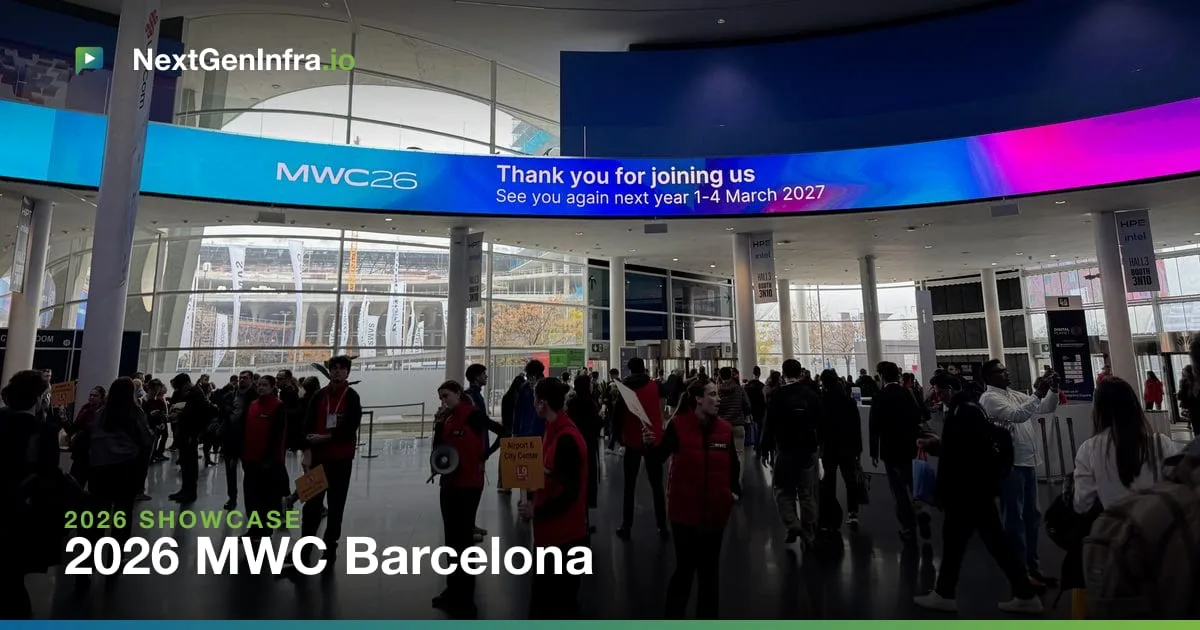
Welcome to the NextGenInfra MWC 2026 Showcase. We're on the ground, grabbing videos from telco's leading executives at the GSMA's MWC in Barcelona amidst the 100K+ human attendees (all armed with their AI agents). We will upload videos as best we can, while we're on the go.
Meanwhile, as you patiently await the full complement of videos from the show, grab our latest research brief right from this page.
AI Inference Network Fabric: Low Latency Solutions for Service Providers
Building Service Provider Networks for the AI Era
Building AI-Ready Networks for the Service Providers
AI Powered Network Automation
GSMA Launches Open Telco AI
Distributed AI Workloads Reshape Network Infrastructure
The New Open Centralized Unit Distributed Unit (OCUDU) Effort
From Standardization to AI-Driven Consumption
Network Visibility Across Domains
Physical AI in Action
Nokia's 800G Pluggables for AI Data Center Networks
90% of Telcos See Revenue Gains from AI
Latest Research Brief
Download Our Latest Report
Data Center Networking in 2026 — Scaling to New Heights
More about this report →
No personal info needed to download
By downloading this report, you agree to our Terms of Use and Privacy Policy.
What we learned at MWC 2026
Twelve conversations in Barcelona point to one shift: AI stopped being a telco experiment and became the business plan.
Telcos moved from AI pilots to AI P&L
NVIDIA's fourth annual telco AI report found 90% of operators say AI is already raising revenue or cutting costs, with planned AI spending jumping from 65% to 89% year over year. DriveNets' pitch captures the ambition: run GPU-as-a-service on existing infrastructure and become a neo-cloud.
Service provider networks are being rebuilt for inference
Arrcus debuted an inference network fabric aimed at low latency, data sovereignty, and cost per inference; Cisco positions purpose-built silicon and routing for AI-era traffic that must stay within sovereign boundaries; and Nokia's 800G pluggables cut DCI power 65–70% for operators moving AI traffic between core and edge.
AI-native networks are coming before 6G
77% of operators in NVIDIA's survey expect AI-native networks before 6G ships. The GSMA's new Open Telco AI initiative with AT&T and Deutsche Telekom aims to build 'telco grade AI' — with benchmarks, shared datasets, and deployable root-cause analysis — rather than waiting for general-purpose models to learn telecom.
Physical AI escaped the lab
Nokia's Surf delivery trucks carry Nvidia Jetson GPUs across seven US cities for DoorDash and Uber Eats, while Nokia, Nvidia, and T-Mobile build an 'AI grid' that distributes processing across devices, AI-RAN, and network layers. The radio network is becoming an inference platform.
Openness gets practical: merchant silicon and agent-callable APIs
Marvell argues wireless differentiation is shifting to software atop standardized silicon, backed by Linux Foundation OCUDu and OCP harmonization. On the services side, CAMARA's 60 stable telco APIs are pivoting to channel products — and to MCP servers, so agentic AI can discover and call network capabilities directly.
Highlights from industry thought leaders









Video interviews
AI Inference Network Fabric: Low Latency Solutions for Service Providers
- Arrcus debuts an inference network fabric targeting low latency, data sovereignty, and lower cost per inference for agentic and physical AI
- Fujitsu partnership pairs the Monaka processor with Arrcus' programmable OS and Oneinity optical interconnect
- Lightstorm named as a customer, spanning edge 5G, multicloud networking, and data centers
Abstract
Building Service Provider Networks for the AI Era
- AI-era SP networks must handle high traffic volumes, latency-sensitive workloads, and traffic secured within sovereign boundaries
- Cisco positions its new Silicon 1 technology and routing systems as purpose-built for these AI-era demands
Abstract
Building AI-Ready Networks for the Service Providers
- Dell's XR9700 is the industry's first outdoor-capable server, running cloud RAN and edge AI on Intel Xeon 6
- It closes the performance gap between traditional and cloud-based radio systems
- Dell expects significant cloud RAN deployments as architectures go cloud-native for AI
Abstract
AI Powered Network Automation
- DriveNets pursues a dual AI strategy: automation for autonomous SP operations plus new AI revenue on existing infrastructure
- The same infrastructure serves both legacy services and GPU-as-a-service offerings
- Operators can build GPU clusters and become neo-clouds to capture the AI market
Abstract
GSMA Launches Open Telco AI
- GSMA launches Open Telco AI with AT&T and Deutsche Telekom to build "telco grade AI"
- Targets today's gaps in understanding telecom standards and deployable, at-scale root cause analysis
- Community-driven model with benchmarks, datasets, competitions, hackathons, and code sharing at gsma.com/opentelcoai
Abstract
Distributed AI Workloads Reshape Network Infrastructure
- AI workloads are distributing beyond the data center, demanding robust networking across many sites
- HPE-Juniper integration unifies compute, storage, networking, and security, including cloud-native routing in ProLiant edge servers
- New SPX 12000 router delivers 500+ TB/s in 32RU with 800G and 1.6T readiness, deep buffers, and line-rate security
Abstract
The New Open Centralized Unit Distributed Unit (OCUDU) Effort
- Wireless vendors are shifting to software differentiation atop standardized CPUs and GPUs
- Linux Foundation OCUDu and OCP projects open the door to hardware harmonization
- Marvell claims to be the only provider of macro-grade merchant silicon, trading custom silicon for better cost and power at scale
Abstract
From Standardization to AI-Driven Consumption
- The telco API ecosystem reached 60 stable APIs in 2025, now pivoting to customer value via channel-partner and aggregated API products
- Agentic AI and LLMs need to discover and call APIs through MCP servers
- CAMARA is adapting its guidelines to support both product development and MCP server deployment
Abstract
Network Visibility Across Domains
- Nokia's end-to-end view spans mobile, core, submarine, and data center interconnect networks
- RAN and access visibility informs optical solutions tuned to RAN-to-data-center traffic
- The result is positioned as a more holistic, cross-domain network solution
Abstract
Physical AI in Action
- Nokia's physical AI push features Surf delivery trucks with Nvidia Jetson GPUs across seven US cities via DoorDash and Uber Eats
- Nokia, Nvidia, and T-Mobile are building an "AI grid" distributing processing across devices, AI RAN, and network layers
- Enables safe navigation, human assistance, and multilingual support via LLMs running on the radio network
Abstract
Nokia's 800G Pluggables for AI Data Center Networks
- Nokia's 800G pluggables for data center interconnect cut power consumption 65-70% versus embedded optics
- Power savings are a key draw for constrained operators handling AI traffic between core and edge
- Vertical integration at its California indium phosphide fab yields ZR/ZR+ edge in transmission distance and supply chain control
Abstract
90% of Telcos See Revenue Gains from AI
- NVIDIA's fourth annual AI report finds 90% of telcos say AI is already raising revenue or cutting costs
- Planned AI spending jumped from 65% in 2024 to 89% in 2025
- 77% expect AI-native networks before 6G, targeting spectral and energy efficiency, performance, and personalization
Abstract
By downloading this report, you agree to our Terms of Use and Privacy Policy.
Continue exploring
More executive showcases across next-gen infrastructure.

2026 Predictions
Infrastructure tech leaders review 2025 and share 2026 predictions for AI, networking, cloud, security, datacenter, and 5G/6G.
2025 AI in Networking
Thought leaders discuss using predictive, generative, and agentic AI to manage, automate, scale, and optimize network infrastructure
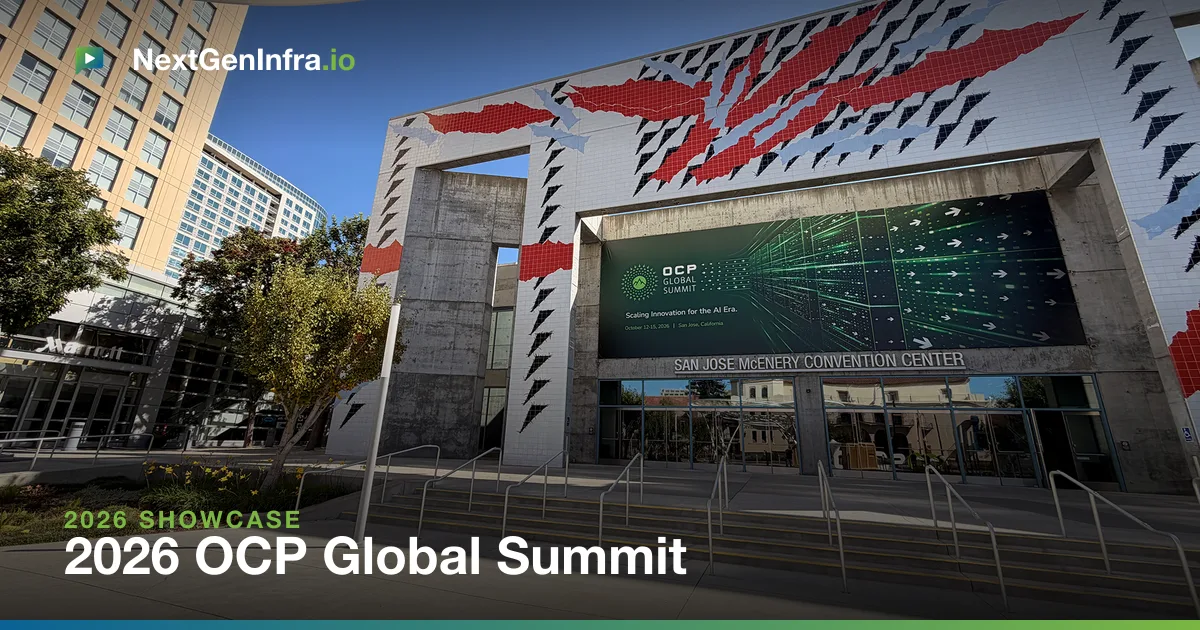
2026 OCP Global Summit
Exclusive videos from OCP Global Summit 2026 (Oct 12-15, San Jose). Topics: co-packaged optics, 800V racks, AI inference disaggregation, edge DPUs, AI computing continuum