

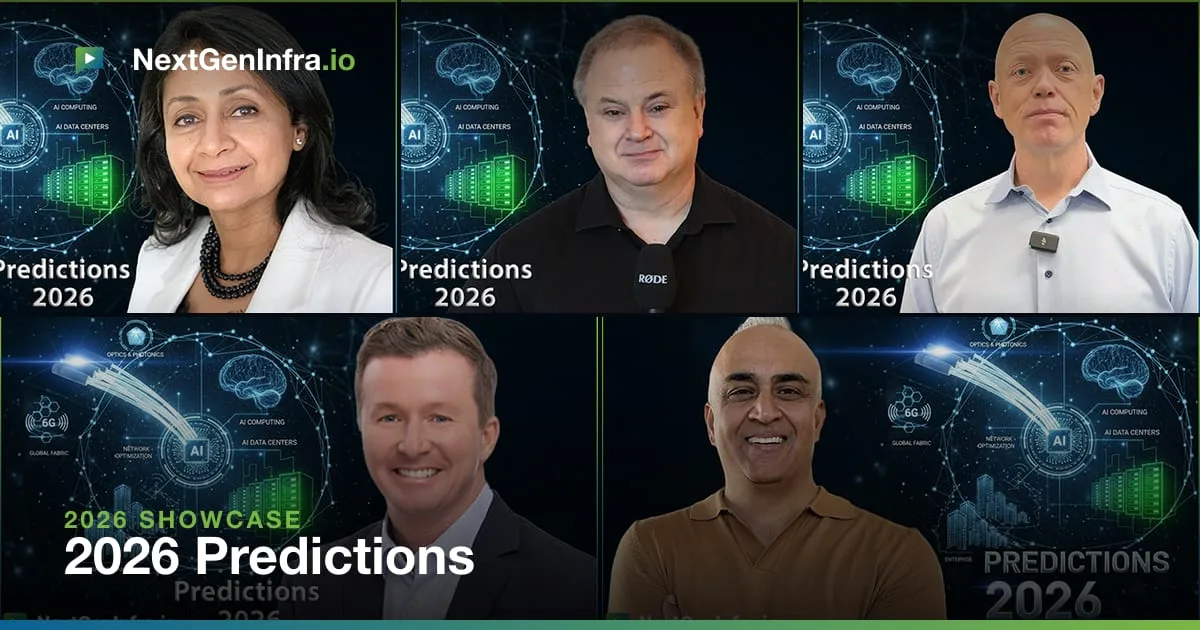
2026 Predictions Showcase
Also, grab our latest research brief right from this page.
AI, Security & New Revenue Opportunities
Specialized Accelerators, Hybrid Fabrics & Tiered Memory
Data Center Power, Water & AI Infrastructure Trends
Telecom's Shift from Automation to Autonomy
Ethernet Dominance, Multi-Site Clusters & Co-Packaged Optics
5 Fiber Industry Trends Shaping 2026
Inference, Neoclouds & Reliability Challenges
GPUs diversity and Ethernet in Scale-Up
Cellular, Sovereign Cloud & Supply Chain Issues
Ethernet's Path to AI Dominance
Fiber Growth, Quantum & AI Infrastructure
AI Bubble Correction in 2026: Network Infrastructure's Critical Role
The Future of Ethernet: 200G to 3.2T and Beyond
AI CPU Deployments, Edge Computing & 6G
Optical Networks, AI Chip Design & Memory Architecture
OIF on 448G, Coherent Lite, CMIS & Power Efficiency
AI Infrastructure, Bandwidth, Timing & Robotics
5G Advanced, Telco AI, Satellite-to-Device & 6G
AI Data Centers, Quantum Security & Sensing Convergence
When AI Gets Normal (Not Smarter)
3 Predictions for Enterprise AI and Infrastructure in 2026
Latest Research Brief
Download Our Latest Report
Data Center Networking in 2026 — Scaling to New Heights
More about this report →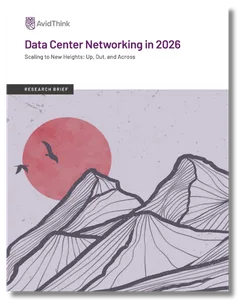
No personal info needed to download
By downloading this report, you agree to our Terms of Use and Privacy Policy.
What the 2026 predictions point to
Across these infrastructure leaders, 2026 is the year AI stops being about bigger models and starts being about the physics and economics of running them at scale. The recurring throughline: inference, power, and the network fabric become the real battlegrounds, with Ethernet and a maturing optical roadmap underpinning it all.
The year of inference
AI shifts from training to decode-heavy inference, demanding far more memory capacity and forcing new economics. Credo, YOUnified AI, and Zayo all frame 2026 as the year inference costs reshape pricing, deployment, and ROI expectations.
Power and cooling become the gating constraint
Compute is limited by electricity and heat, not silicon. Adtran, Black & Veatch, and YOUnified AI point to collocated generation, SMRs, GPU-driven water management, and local politics making geography a first-order design factor.
Ethernet wins the AI fabric
Broadcom, DriveNets, Ethernet Alliance, and IEEE converge on Ethernet as the standard from scale-up to scale-out, with the 802.3dj roadmap pushing 200 Gbps signaling toward 1.6T and 400 Gbps signaling toward 3.2T and beyond.
Optics, memory, and timing move center stage
Marvell, OIF, Astera Labs, and SiTime highlight the enabling layers: co-packaged and increasingly fully optical connectivity, 400/448 Gbps and coherent lite, tiered memory beyond HBM, and resilient timing to keep GPUs and robots running.
Autonomy, sovereignty, and a reality check
Telecom shifts from automation to autonomy (Blue Planet), geopolitics drives sovereign and private cloud (Ericsson, Adtran), quantum and post-quantum security rise, and Graphiant expects an AI-bubble correction that refocuses the market on real business value.
Highlights from industry thought leaders
















Video interviews
AI, Security & New Revenue Opportunities
- AI continues to dominate the industry in 2026, but power consumption is the binding constraint
- Digital sovereignty and security advance, including post-quantum cryptography
- Service providers evolve beyond infrastructure into digital platforms
Abstract
Specialized Accelerators, Hybrid Fabrics & Tiered Memory
- Specialized accelerators take center stage as workloads demand adaptability and flexibility
- Hybrid AI fabrics combine multiple protocols rather than a single interconnect standard
- Tiered memory architectures address large-scale inference workloads
Abstract
Data Center Power, Water & AI Infrastructure Trends
- Power suppliers and data center developers deepen partnerships, with collocated generation and SMRs becoming more prevalent
- GPU cooling demands in warmer regions drive significant water management innovation
- Neocloud providers offer distributed AI-as-a-service in the 20-80 MW range
- Integrated campus simulations and AI-enabled operations become standard practice
Abstract
Telecom's Shift from Automation to Autonomy
- Telecom shifts from automation to autonomy, with accurate OSS data a prerequisite for agentic AI
- Autonomous network use cases move from pilots into production environments
- CSPs accelerate legacy OSS decommissioning, retiring decades-old mainframes that block AI
Abstract
Ethernet Dominance, Multi-Site Clusters & Co-Packaged Optics
- Ethernet becomes the standard for scale-up networking
- AI clusters expand across multiple data centers with Ethernet as the interconnecting fabric
- Co-packaged optics go mainstream on the back of 70% power efficiency gains
Abstract
5 Fiber Industry Trends Shaping 2026
- BEAD funding and public-private partnerships accelerate global fiber deployment
- Simplified design and training grow in importance to counter workforce shortages
- Higher-capacity hardware and multi-gigabit technologies drive speed and density gains
Abstract
Inference, Neoclouds & Reliability Challenges
- 2026 is "the year of inference" as AI shifts from training to decode-heavy applications
- Decode-heavy inference requires significantly more memory capacity
- AI spending moves from traditional hyperscalers to neoclouds needing vendor support for rapid deployment
Abstract
GPUs diversity and Ethernet in Scale-Up
- The GPU market grows more heterogeneous, moving beyond a single dominant vendor
- Networking becomes a critical AI infrastructure design consideration
- Ethernet emerges as the leading technology across all connections, from scale-up to scale-out
Abstract
Cellular, Sovereign Cloud & Supply Chain Issues
- Cellular becomes a viable alternative to wired connections on technological and financial grounds
- Geopolitical factors drive adoption of sovereign and private cloud for security and autonomy
- DDR4 memory shortages impact network product lifecycles across the industry
Abstract
Ethernet's Path to AI Dominance
- Ethernet will succeed in AI applications despite uncertainty over the specific path forward
- The industry understands its objectives and will determine the approaches needed to meet customer requirements
Abstract
Fiber Growth, Quantum & AI Infrastructure
- 2026 sees record fiber deployment driven by private investment and BEAD program funding
- Quantum networking becomes critical as "Q Day" threats accelerate the need for enhanced encryption
Abstract
AI Bubble Correction in 2026: Network Infrastructure's Critical Role
- A significant AI-bubble correction hits as model scaling and data center expansion plateau
- Focus shifts from raw scaling toward actual business value and real-world applications
Abstract
The Future of Ethernet: 200G to 3.2T and Beyond
- The 802.3dj standard nears completion, introducing 200 Gbps signaling for speeds up to 1.6T Ethernet, with products already shipping
- The industry moves to define 400 Gbps signaling as the foundation for 3.2T Ethernet and beyond
Abstract
AI CPU Deployments, Edge Computing & 6G
- Widespread AI deployments use CPU-native capabilities for radio algorithms and infrastructure optimization
- Enterprises adopt on-premises edge computing with multi-tenancy support
- The industry intensifies focus on defining 6G standards and monetization strategies
Abstract
Optical Networks, AI Chip Design & Memory Architecture
- Hybrid electrical-optical connectivity evolves toward fully optical by 2027
- AI capabilities become more deeply integrated into chip design technologies
- Memory capacity expands beyond traditional HBM via attached or disaggregated architectures
Abstract
OIF on 448G, Coherent Lite, CMIS & Power Efficiency
- The industry pushes toward 400/448 Gbps implementation while tackling reliability, power efficiency, and reach
- Coherent lite emerges as a developing market segment
- CMIS becomes critical firmware infrastructure for AI applications
Abstract
AI Infrastructure, Bandwidth, Timing & Robotics
- AI infrastructure drives demand for resilient timing to keep expensive GPUs running continuously
- Networking bandwidth transitions from 800G to 1.6 Tbps
- AI-enabled robotics require precision timing under extreme conditions where humans cannot operate
Abstract
5G Advanced, Telco AI, Satellite-to-Device & 6G
- 5G Advanced gains momentum via RedCap IoT and location services
- Telcos monetize AI with offerings like GPU-as-a-service
- Non-terrestrial direct-to-device capabilities expand beyond emergency use cases
- 6G standardization accelerates around new spectrum bands, integrated sensing, and cybersecurity
Abstract
AI Data Centers, Quantum Security & Sensing Convergence
- Convergence of networks, security, AI, photonics, and sensing reshapes how infrastructure is designed, deployed, and tested
- High-speed data center networking and AI in RAN change testing requirements
- AI-enabled cybersecurity threats emerge as a growing concern
Abstract
When AI Gets Normal (Not Smarter)
- AI becomes "normal" as infrastructure economics, security, and compute politics eclipse model-intelligence gains
- Inference costs force new SaaS pricing models
- AI security shifts from policy to system-design requirements
- Data center power demands make geography and local politics critical factors
Abstract
3 Predictions for Enterprise AI and Infrastructure in 2026
- Enterprise AI adoption enters an expansion phase with more ROI evaluations and operational integration
- The Neocloud vertical sees market separation between winners and strugglers amid capital-intensity pressures
Abstract
By downloading this report, you agree to our Terms of Use and Privacy Policy.
Continue exploring
More executive showcases across next-gen infrastructure.

2026 MWC Barcelona
Leading executives at MWC 2026 in Barcelona discussing AI, ML, GenAI, agentic AI, AI-RAN, O-RAN, 5G-Advanced, 6G, and plenty more AI.
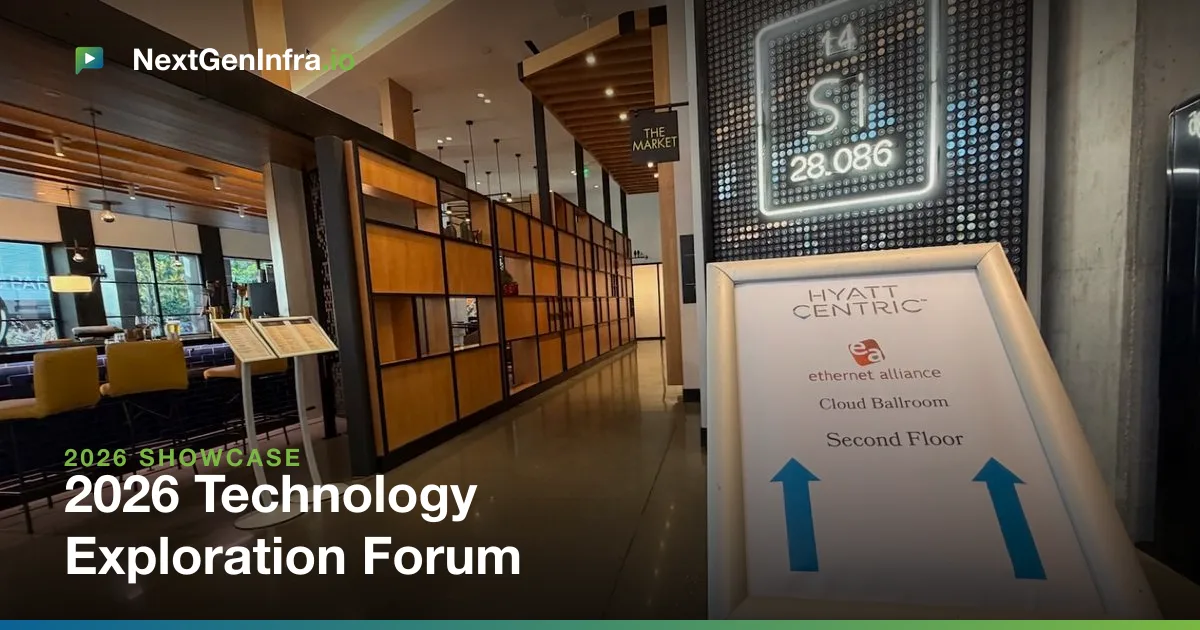
2026 Technology Exploration Forum
Highlights from Ethernet Alliance's 2026 TEF. Topics: 224/448 Gbps/lane, 1.6/3.2 Tbps, AI fabric, InfiniBand, UCIe, CXL, PCIe Gen 6/7
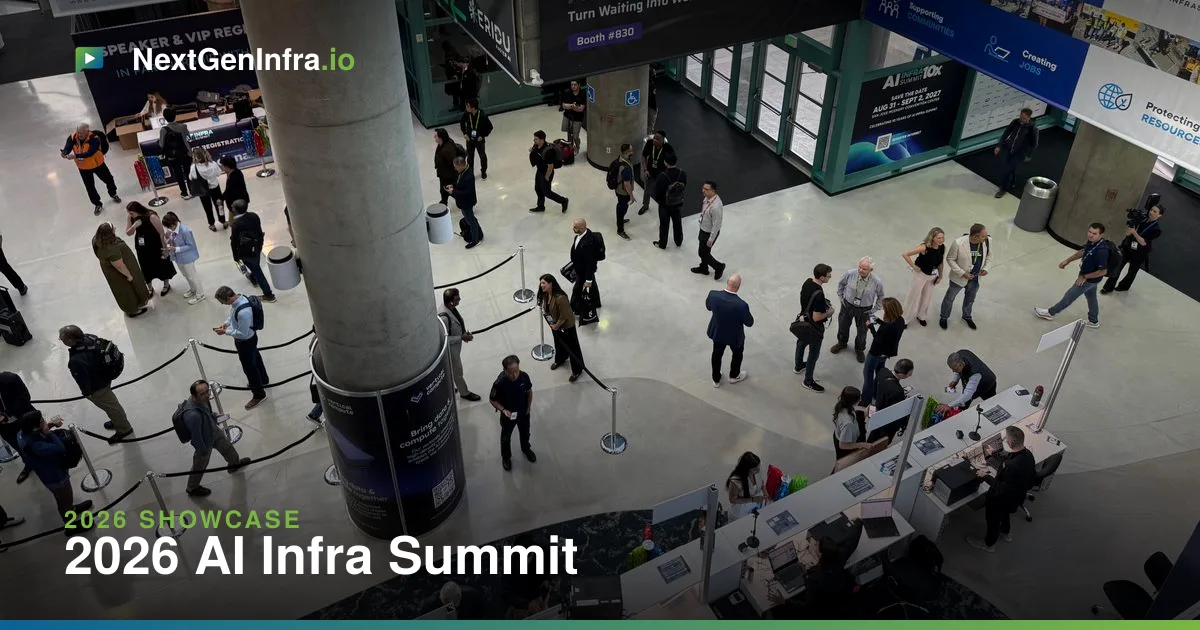
2026 AI Infra Summit
Executives at AI Infra Summit 2026 in Santa Clara discuss full-stack AI infrastructure — chips, interconnects, networking, memory, storage, power, and the data centers behind AI training and inference