

2023 AI and Cloud DC Networking Showcase
Download the report for free — courtesy of our sponsors! Join the other enterprise IT, CSP, DC operators, and other thought leaders who've already download the report.
Unleashing CXL Tech's Potential in AI & Data Center Evolution
Ampere's Vision for Power-Efficient, Large-Scale AI Computing
Data Center Architecture Spanning Edge to Cloud with AI & 5G
Democratizing Networking with SONiC
CPO Switches are Here!
The Year AI Skyrockets: Overcoming Bandwidth Bottlenecks
Unveiling the Future of AI: Large-Scale Applications & High-Speed Networks
The Arms Race for AI Clusters
AI/ML Leads to Massive Traffic Across the Network
Scaling AI Clusters: Optical Connectivity's Key Role in Data Transport
GenAI will Super Charge Network Operators
Faster Interconnects for AI Data Centers
Offloading infrastructure to IPUs frees host CPUs, accelerates apps, and enhances security
Optics Leads the Way for Next Gen Data Centers
Harnessing CXL for AI/ML Interconnectivity
Future of Data Centers: Chiplets, Bandwidth & AI-Intensive Workloads
Advancing the Open Chiplet Economy
What's Next for Chiplets
Integrating Chiplets into Complete Systems
Zero Gap AI - Vapor.io, SuperMicro, NVIDIA
Courtesy of our sponsors!
Complimentary Report Download
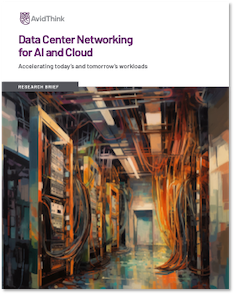
2023 AI and Cloud Data Center Networking
No personal info needed to download
By downloading this report, you agree to our Terms of Use and Privacy Policy.
What the 2023 AI and Cloud DC Networking report finds
AI's explosive growth is straining data center interconnects, and the bottleneck has shifted to the physical and optical layers feeding GPU clusters. Across these interviews, higher-speed optics, chiplets, CXL memory pooling, and open networking software emerge as the levers vendors are pulling to keep AI backend networks scaling.
Optics is the scaling bottleneck
Brad Booth, OIF's Nathan Tracy, and Marvell's Radha Nagarajan point to bandwidth density as the constraint, with OIF developing 200G electrical and 112G linear optics and Marvell shipping a 1.6T DSP for AI clusters.
800G to 1.6T backend networks
Dell'Oro's Sameh Boujelbene projects two-thirds of AI backend ports at 1.6T by 2027 with all at least 800G, while Credo and Multilane push 100G single-lane and 800G interconnect systems.
Chiplets replace monolithic chips
OCP's Cliff Grossner, Synopsys, Thrace Systems, and ODSA lead Bapi Vinnakota advance an open chiplet economy with electronic data sheets, integration workflows, and open interfaces for heterogeneous AI systems.
CXL pools memory for AI
Siamak Tavallaei says CXL can interconnect 10,000 units and petabytes of shared memory, while 650 Group's Alan Weckel positions CXL as a competitor to NVLink for AI and ML servers.
Open software and offload
Broadcom democratizes networking via open-source SONiC with silicon telemetry, Napatech offloads infrastructure to IPUs freeing host CPUs, and Microsoft frames managing the network as an API.
Co-packaged optics and power efficiency
Broadcom's Near Margalit announces CPO switches clearing key technical hurdles, while Ampere's 192-core One CPUs target efficient inference at 200 to 400 watts.
Highlights from industry thought leaders















Video interviews
Unleashing CXL Tech's Potential in AI & Data Center Evolution
- 650 Group's Alan Weckel positions CXL to compete with NVLink for enhancing AI and machine learning servers.
- Growing bandwidth demand requires new and multiple switches per rack, with spending shifting from cloud to AI.
Abstract
Ampere's Vision for Power-Efficient, Large-Scale AI Computing
- Ampere's Sean Varley stresses optimizing AI models for power efficiency alongside large-scale computing needs.
- Ampere's 192-core AmpereOne parts deliver high compute for inference at less than 200 to 400 watts.
Abstract
Data Center Architecture Spanning Edge to Cloud with AI & 5G
- Arrcus introduces FlexMCN network fabric overlay and SRv6 mobile user plane technology built for SoftBank Mobile.
- ArcIQ delivers end-to-end network visibility, with 5G as transport for AI/ML while optimizing GPU utilization and TCO.
Abstract
Democratizing Networking with SONiC
- Broadcom democratizes networking with open-source SONiC, bringing hyperscaler features to all users.
- Enhanced enterprise-class SONiC and silicon telemetry help customers quickly root-cause network and application issues.
Abstract
CPO Switches are Here!
- Broadcom's Near Margalit says the company has tackled the main technical challenges of deploying CPO switches.
- Focus now shifts to proving reliability and cost-effectiveness of silicon photonics and shortening time to market.
Abstract
The Year AI Skyrockets: Overcoming Bandwidth Bottlenecks
- Credo Semi's Bill Brennan forecasts 2023 as AI's pivotal year, with interconnect bandwidth as the key bottleneck.
- Credo targets the AI cluster backend network, driving a global shift to 100 Gig single lane connections.
Abstract
Unveiling the Future of AI: Large-Scale Applications & High-Speed Networks
- Dell'Oro's Sameh Boujelbene says large AI applications require a new AI backend network and market opportunity.
- By 2027, two-thirds of backend network ports will be 1.6T and all at least 800 gig.
Abstract
The Arms Race for AI Clusters
- Independent advisor Brad Booth describes AI data centers expanding rapidly as hyperscale and cloud players adopt AI.
- High GPU and optical module demand is spurring exploration of new materials for optics and memory to meet bandwidth needs.
Abstract
AI/ML Leads to Massive Traffic Across the Network
- Juniper's Mansour Karam expects the data center market to reach $32 billion in four years, driven by AI/ML workloads.
- Software must optimize job completion time and auto-tune AI/ML parameters, drawing on Juniper and acquired Apstra expertise.
Abstract
Scaling AI Clusters: Optical Connectivity's Key Role in Data Transport
- Marvell's Radha Nagarajan stresses optical connectivity for managing data transport as AI clusters grow.
- Marvell's 1.6 DSP for the 1.60 generation is ready to meet demand in AI-centric data centers.
Abstract
GenAI will Super Charge Network Operators
- Microsoft's Shawn Hakl sees software-based operations enhancing customer experience and network management efficiency.
- Managing the network as an API can modernize and monetize networks in innovative ways.
Abstract
Faster Interconnects for AI Data Centers
- Multilane's Hani Daou cites rising compute needs driving investment in 100 terabit AS6 and 200 gigabit per Lambda optics.
- Multilane sees high demand for its 800 gig systems and copper interconnect test solutions serving chip vendors and cloud providers.
Abstract
Offloading infrastructure to IPUs frees host CPUs, accelerates apps, and enhances security
- Napatech's Charlie Ashton says IPUs accelerate networking, storage, and security while freeing host CPUs for applications.
- Napatech's hardware-plus-software IPU solutions offload servers and add workload isolation for greater security.
Abstract
Optics Leads the Way for Next Gen Data Centers
- OIF's Nathan Tracy says machine learning demands higher bandwidth density, straining power and thermal management.
- OIF is developing 200 Gbps electrical interfaces, a 112 Gbps linear optics spec, and Energy-Efficient Interfaces.
- OIF also works on CMIS management specs and 400ZR, 800ZR, and 1600ZR for next-gen data centers.
Abstract
Harnessing CXL for AI/ML Interconnectivity
- OCP's Siamak Tavallaei stresses CXL for interconnecting large machine learning systems with a fundamental interconnect standard.
- CXL can link 10,000 units, petabytes of storage, and hundreds of terabytes of shared memory for device and host communication.
Abstract
Future of Data Centers: Chiplets, Bandwidth & AI-Intensive Workloads
- OCP ODSA lead Bapi Vinnakota highlights chiplets' efficiency in building heterogeneous systems for growing bandwidth needs.
- Chiplet-based systems will be crucial for AI-intensive data centers, with open interfaces as the optimal integration path.
Abstract
Advancing the Open Chiplet Economy
- OCP's Cliff Grossner describes standardizations letting companies build a chiplet and publish an electronic data sheet for others' design tools.
- OCP revealed plans to establish a marketplace for chiplets.
Abstract
What's Next for Chiplets
- Synopsys highlights cost-effective chiplets over monolithic chips as the industry nears the limits of electronics.
- That physical ceiling makes a shift to chiplets increasingly likely.
Abstract
Integrating Chiplets into Complete Systems
- Thrace Systems, leading the CDX work stream under ODSA, announced an upcoming white paper on chiplet integration workflows.
- The paper covers all aspects of chiplet integration and will publish on the Open Compute Project website.
Abstract
Zero Gap AI - Vapor.io, SuperMicro, NVIDIA
- Vapor introduces Zero Gap AI, an end-to-end service simplifying wireless and AI stack deployment.
- The offering partners with Super Micro and leverages NVIDIA's Grace Hopper superchip and MGX platform.
Abstract
By downloading this report, you agree to our Terms of Use and Privacy Policy.
Continue exploring
More executive showcases across next-gen infrastructure.
2026 Technology Exploration Forum
Highlights from Ethernet Alliance's 2026 TEF. Topics: 224/448 Gbps/lane, 1.6/3.2 Tbps, AI fabric, InfiniBand, UCIe, CXL, PCIe Gen 6/7

En Route To Series
In-depth and fun interviews with tech execs in Waymo, Rideshare at major events in Silicon Valley: RSAC, OFC, GTC, OCP, etc
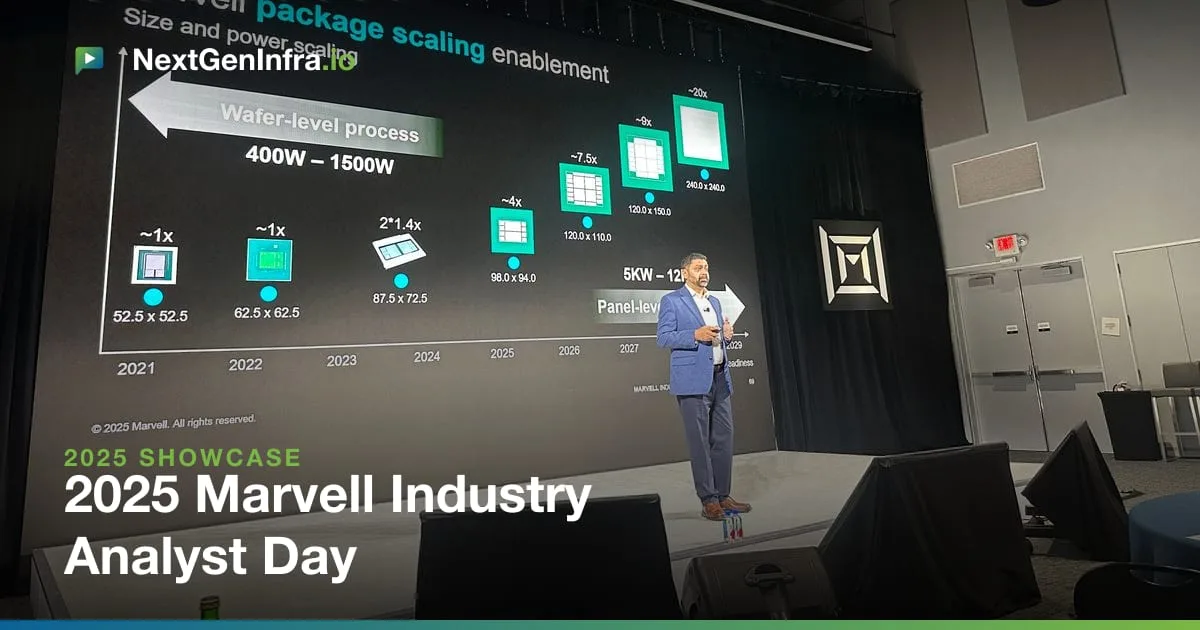
2025 Marvell Industry Analyst Day
Marvell executives share their vision for accelerated infrastructure and how Marvell's technology portfolio speeds up AI and cloud workloads