2024 Showcase
Technology Exploration Forum Showcase
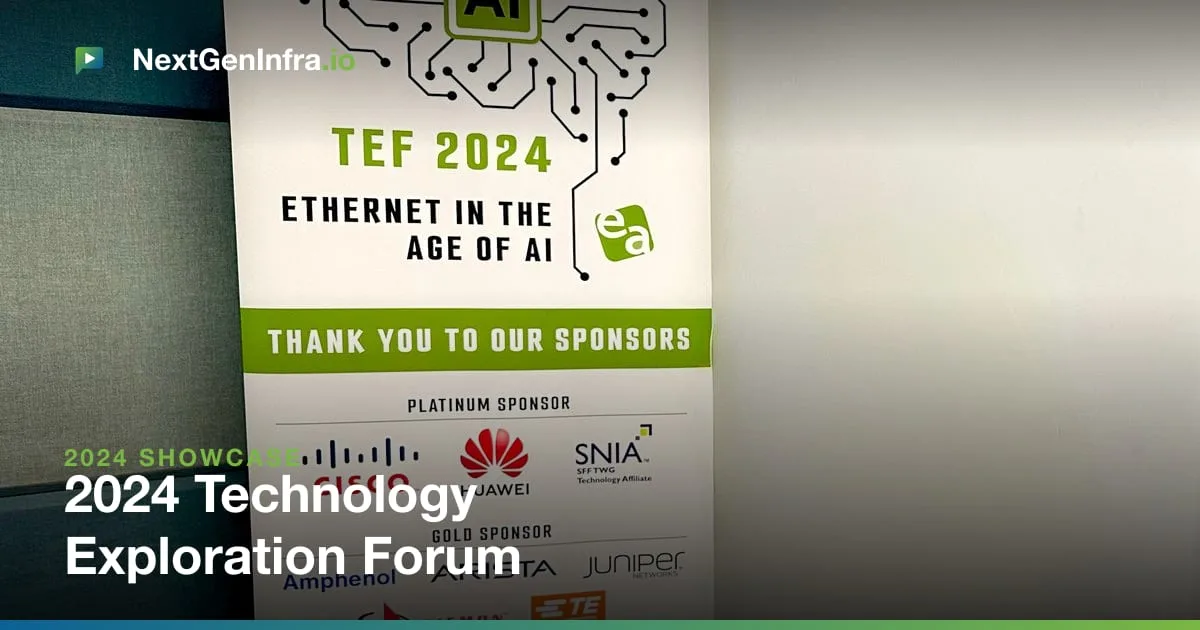
The Ethernet Alliance held their Technology Exploration Forum (TEF) exploring Ethernet in the Age of AI in Santa Clara, CA on October 22-23, 2024 at the Santa Clara Convention Center. The NextGenInfra.io team was on the ground to capture thought leader perspectives on changes and evolution needed in Ethernet to support AI/ML workloads — both on the front-end and back-end (scale out).
While you're here, feel free to grab our latest research brief right from this page.
Sponsor Spotlight 650 Group
AI Reshaping the Ethernet Landscape
Alan Weckel, Founder and Technology Analyst at 650 Group, examines AI's influence on the Ethernet market, highlighting the creation of three networks with faster speeds and a vendor race for new products. He discusses the rapid growth in high-speed Ethernet port adoption and the expanding data center switching market, noting Nvidia's entry into Ethernet semiconductors and systems as a key development.
Sponsor Spotlight Alphawave Semi
Unlocking AI's Potential: Connectivity and Collaboration
Tony Chan Carusone, Chief Technology Officer of Alphawave Semi, emphasizes the importance of connectivity and industry collaboration in advancing AI technologies across multiple fronts. He highlights Alphawave Semi's contributions in chiplets and high-speed series technologies, including custom silicon solutions and IP offerings for die-to-die interfaces and transceivers for AI processor connectivity.
Sponsor Spotlight Astera Labs
Optimizing Networking for AI Scale and Performance
Christopher Blackburn, System Architect & Director of Field Applications Engineering at Astera Labs, explores the challenges and future of AI networks, focusing on the diverse requirements of different network types and the need for optimization as networks expand. He discusses how Astera Labs' product line, including PCIe and Ethernet retimers, offers intelligent connectivity solutions to address channel challenges in various AI architectures.
Sponsor Spotlight Cisco Systems
AI-Driven Networks for the Future
Jiri Chaloupka, Principal Engineer Technical Marketing at Cisco Systems, explores the progression of internet technology towards AI-driven networks, emphasizing the need to build upon existing Ethernet standards while addressing new AI-specific challenges. He underscores the importance of industry collaboration and standardization to support the unique requirements of AI networks, including high bandwidth, low latency, and large-scale GPU interconnectivity.
Sponsor Spotlight Dell'Oro Group
Analyzing the Market Impact of AI Networks
Sameh Boujelbene, Vice President at Dell'Oro Group, examines the rapid evolution of AI workload networks, highlighting accelerated refresh cycles and increasing bandwidth demands. She discusses the competition between InfiniBand and Ethernet in the AI cluster market, noting Ethernet's growing adoption due to technological advancements and hyperscaler preferences.
Sponsor Spotlight Ethernet Alliance
Ethernet's Future: Technical Collaboration for Scaling to the AI Challenge
Peter Jones, Chair of the Ethernet Alliance, discusses the Ethernet in the Age of AI Networking event, emphasizing industry collaboration to address challenges in meeting requirements. Jones expresses confidence in Ethernet's ability to overcome obstacles and anticipates that the event will lead to greater industry alignment in addressing AI networking challenges.
Sponsor Spotlight Ethernet Alliance
Ethernet Evolution: Powering High-Speed AI Connections
John D'Ambrosia, Chair of the IEEE P802.3dj Task Force and adviser to the Ethernet Alliance board of directors, discusses how Ethernet's growth supports the AI ecosystem. He introduces the two-day Technology Exploration Forum covering issues impacting faster data rates, focusing on 200 Gbps signaling to enable higher-speed Ethernet connections up to 1.6 Tbps.
Sponsor Spotlight EXFO
Ethernet's AI Era: Navigating 400G Per Lane Challenges
David Rodgers, Technical Business Development Manager at EXFO, explores the complexities and opportunities of Ethernet in the AI era, focusing on the challenges of achieving 400 Gig per lane speeds. He discusses the potential need for specialized testing and emphasizes the importance of collaboration within the industry to overcome these hurdles.
Sponsor Spotlight Google
Ethernet's Future in AI Networks
Moray McLaren, Principle Engineer at Google, explores Ethernet's capabilities in addressing interconnect challenges for machine learning networks, highlighting Google's use of an Ethernet-based proprietary network in their TPU systems. He suggests Ethernet's potential dominance in scale-out and host networks for ML applications, while acknowledging the need for alternative solutions in more latency-sensitive architectures.
Sponsor Spotlight IEEE
Adapting Ethernet for AI, ML, and HPC Networking Challenges
Kent Lusted, 802.3dj Electrical Track Chair at IEEE, explores the ongoing development of Ethernet to address market demands and customer applications in AI, ML, and HPC. He examines the challenges of balancing component requirements and adapting Ethernet capabilities for future needs, emphasizing the importance of addressing both scale-out and scale-up networks in AI.
Sponsor Spotlight Intel
Powering AI's Future with Advanced Ethernet
Mike Li, a Fellow at Intel, discusses high-speed networking advancements for AI applications, including 200 Gbps per lane Ethernet specifications and development of 800 Gbps/1.6 Tbps Ethernet. Li emphasizes Ethernet's importance for GPU acceleration and clustering architectures, while also highlighting ongoing work towards 400 Gbps per lane speeds and future generations reaching up to 6.4 Tbps.
Sponsor Spotlight Intel
Ethernet Interoperability in the AI Age
Sam Johnson, Link Applications Engineering Manager at Intel, emphasizes the critical role of Ethernet interoperability in networking and AI applications. As chair of the Ethernet Alliance's highspeed networking subcommittee, Johnson highlights the organization's efforts to promote collaboration and testing among vendors to advance the Ethernet ecosystem.
Sponsor Spotlight Intel
Building Ultra Ethernet for AI Data Center Evolution
Uri Elzur, GPU Networks and System Architecture at Intel, outlines the Ultra Ethernet Consortium's approach to addressing AI-related challenges in data center architecture and networking. He describes the consortium's collaboration with the Ethernet Alliance to enhance Ethernet's capabilities for AI applications through optional features like link-level retry and credit-based flow control.
Sponsor Spotlight OIF
Achieving 400G Ethernet: Industry Challenges in the AI Era
Nathan Tracy, President of OIF, outlines industry efforts to achieve 400 Gbps Ethernet for AI applications at the Ethernet Alliance's Technology Exploration Forum. Tracy highlights OIF's 448 Gbps project, which aims to address challenges and unify the industry, while noting that companies like TE Connectivity are already investigating solutions despite ongoing work on 200 Gbps specifications.
Sponsor Spotlight Open Compute Project (OCP)
Ethernet Insights from OCP Global Summit
Bijan Nowroozi, Chief Technology Officer of Open Compute Project (OCP), discusses the significance of Ethernet in AI's future, emphasizing its technical and economic advantages. The recent OCP Global Summit featured numerous speakers highlighting Ethernet's benefits, with Nowroozi noting that Ethernet is currently experiencing its moment in the industry.
Sponsor Spotlight Samtec
Small Form Factors for High-Speed Ethernet
Thomas Palkert, System Architect at Samtec, represents the small form factor group of SNEA, which defines connectors and transceivers for optical and storage industries. Palkert emphasizes the challenges of density, power, and cost for Ethernet in AI applications, highlighting the need for faster speeds while achieving higher density, lower power consumption, and reduced costs.
Sponsor Spotlight TE Connectivity
Scaling Protocols and Connections for AI
Ashika Pandankeril Shaji, Staff System Architect at TE Connectivity, explores the growing need for high-bandwidth, low-latency products that support various protocols in AI applications. She emphasizes the importance of density and scalability in connectivity solutions, from backplanes to internal cabling, to meet the demands of emerging technologies like CXL.

Latest Research Brief
Download Our Latest Report
Data Center Networking in 2026 — Scaling to New Heights
More about this report →
No personal info needed to download
Download the Latest Report
By downloading this report, you agree to our Terms of Use and Privacy Policy.
Highlights from industry thought leaders












Video interviews
AI Reshaping the Ethernet Landscape
- 650 Group's Alan Weckel says AI is spawning three new networks with faster speeds and a vendor product race.
- High-speed Ethernet port adoption is growing rapidly, with Nvidia entering Ethernet semiconductors and systems.
Abstract
Alan Weckel, Founder and Technology Analyst at 650 Group, examines AI's influence on the Ethernet market, highlighting the creation of three networks with faster speeds and a vendor race for new products. He discusses the rapid growth in high-speed Ethernet port adoption and the expanding data center switching market, noting Nvidia's entry into Ethernet semiconductors and systems as a key development.
Unlocking AI's Potential: Connectivity and Collaboration
- Alphawave Semi stresses connectivity and industry collaboration as key to advancing AI technologies.
- Alphawave contributes chiplets, custom silicon, and die-to-die IP and transceivers for AI processor connectivity.
Abstract
Tony Chan Carusone, Chief Technology Officer of Alphawave Semi, emphasizes the importance of connectivity and industry collaboration in advancing AI technologies across multiple fronts. He highlights Alphawave Semi's contributions in chiplets and high-speed series technologies, including custom silicon solutions and IP offerings for die-to-die interfaces and transceivers for AI processor connectivity.
Optimizing Networking for AI Scale and Performance
- Astera Labs highlights the diverse requirements of different AI network types as networks expand.
- Astera's PCIe and Ethernet retimers provide intelligent connectivity to address channel challenges in AI architectures.
Abstract
Christopher Blackburn, System Architect & Director of Field Applications Engineering at Astera Labs, explores the challenges and future of AI networks, focusing on the diverse requirements of different network types and the need for optimization as networks expand. He discusses how Astera Labs' product line, including PCIe and Ethernet retimers, offers intelligent connectivity solutions to address channel challenges in various AI architectures.
AI-Driven Networks for the Future
- Cisco's Jiri Chaloupka argues AI networks should build on existing Ethernet standards while solving new challenges.
- He stresses standardization for AI needs like high bandwidth, low latency, and large-scale GPU interconnectivity.
Abstract
Jiri Chaloupka, Principal Engineer Technical Marketing at Cisco Systems, explores the progression of internet technology towards AI-driven networks, emphasizing the need to build upon existing Ethernet standards while addressing new AI-specific challenges. He underscores the importance of industry collaboration and standardization to support the unique requirements of AI networks, including high bandwidth, low latency, and large-scale GPU interconnectivity.
Analyzing the Market Impact of AI Networks
- Dell'Oro's Sameh Boujelbene notes AI workload networks drive accelerated refresh cycles and rising bandwidth demand.
- Ethernet is gaining on InfiniBand in AI clusters on technological advances and hyperscaler preferences.
Abstract
Sameh Boujelbene, Vice President at Dell'Oro Group, examines the rapid evolution of AI workload networks, highlighting accelerated refresh cycles and increasing bandwidth demands. She discusses the competition between InfiniBand and Ethernet in the AI cluster market, noting Ethernet's growing adoption due to technological advancements and hyperscaler preferences.
Ethernet's Future: Technical Collaboration for Scaling to the AI Challenge
- Ethernet Alliance chair Peter Jones emphasizes industry collaboration to meet AI networking requirements.
- Jones expects the event to drive greater industry alignment on overcoming AI networking challenges.
Abstract
Peter Jones, Chair of the Ethernet Alliance, discusses the Ethernet in the Age of AI Networking event, emphasizing industry collaboration to address challenges in meeting requirements. Jones expresses confidence in Ethernet's ability to overcome obstacles and anticipates that the event will lead to greater industry alignment in addressing AI networking challenges.
Ethernet Evolution: Powering High-Speed AI Connections
- John D'Ambrosia of the IEEE P802.3dj Task Force explains how Ethernet's growth supports the AI ecosystem.
- The two-day Technology Exploration Forum focuses on 200 Gbps signaling to enable Ethernet up to 1.6 Tbps.
Abstract
John D'Ambrosia, Chair of the IEEE P802.3dj Task Force and adviser to the Ethernet Alliance board of directors, discusses how Ethernet's growth supports the AI ecosystem. He introduces the two-day Technology Exploration Forum covering issues impacting faster data rates, focusing on 200 Gbps signaling to enable higher-speed Ethernet connections up to 1.6 Tbps.
Ethernet's AI Era: Navigating 400G Per Lane Challenges
- EXFO's David Rodgers explores the complexity of achieving 400 Gig per lane Ethernet speeds in the AI era.
- He points to a potential need for specialized testing and industry collaboration to clear these hurdles.
Abstract
David Rodgers, Technical Business Development Manager at EXFO, explores the complexities and opportunities of Ethernet in the AI era, focusing on the challenges of achieving 400 Gig per lane speeds. He discusses the potential need for specialized testing and emphasizes the importance of collaboration within the industry to overcome these hurdles.
Ethernet's Future in AI Networks
- Google's Moray McLaren notes Google uses an Ethernet-based proprietary network in its TPU systems.
- He sees Ethernet potentially dominating scale-out and host networks, but alternatives for latency-sensitive cases.
Abstract
Moray McLaren, Principle Engineer at Google, explores Ethernet's capabilities in addressing interconnect challenges for machine learning networks, highlighting Google's use of an Ethernet-based proprietary network in their TPU systems. He suggests Ethernet's potential dominance in scale-out and host networks for ML applications, while acknowledging the need for alternative solutions in more latency-sensitive architectures.
Adapting Ethernet for AI, ML, and HPC Networking Challenges
- IEEE's Kent Lusted describes ongoing 802.3dj work adapting Ethernet for AI, ML, and HPC applications.
- He stresses addressing both scale-out and scale-up networks while balancing component requirements.
Abstract
Kent Lusted, 802.3dj Electrical Track Chair at IEEE, explores the ongoing development of Ethernet to address market demands and customer applications in AI, ML, and HPC. He examines the challenges of balancing component requirements and adapting Ethernet capabilities for future needs, emphasizing the importance of addressing both scale-out and scale-up networks in AI.
Powering AI's Future with Advanced Ethernet
- Intel's Mike Li discusses 200 Gbps per lane Ethernet and development of 800 Gbps and 1.6 Tbps Ethernet.
- Work is underway toward 400 Gbps per lane, with future generations reaching up to 6.4 Tbps.
Abstract
Mike Li, a Fellow at Intel, discusses high-speed networking advancements for AI applications, including 200 Gbps per lane Ethernet specifications and development of 800 Gbps/1.6 Tbps Ethernet. Li emphasizes Ethernet's importance for GPU acceleration and clustering architectures, while also highlighting ongoing work towards 400 Gbps per lane speeds and future generations reaching up to 6.4 Tbps.
Ethernet Interoperability in the AI Age
- Intel's Sam Johnson emphasizes Ethernet interoperability as critical for networking and AI applications.
- As chair of the Ethernet Alliance's high-speed subcommittee, he promotes vendor collaboration and testing.
Abstract
Sam Johnson, Link Applications Engineering Manager at Intel, emphasizes the critical role of Ethernet interoperability in networking and AI applications. As chair of the Ethernet Alliance's highspeed networking subcommittee, Johnson highlights the organization's efforts to promote collaboration and testing among vendors to advance the Ethernet ecosystem.
Building Ultra Ethernet for AI Data Center Evolution
- Intel's Uri Elzur outlines the Ultra Ethernet Consortium's approach to AI data center networking.
- Optional features like link-level retry and credit-based flow control enhance Ethernet for AI applications.
Abstract
Uri Elzur, GPU Networks and System Architecture at Intel, outlines the Ultra Ethernet Consortium's approach to addressing AI-related challenges in data center architecture and networking. He describes the consortium's collaboration with the Ethernet Alliance to enhance Ethernet's capabilities for AI applications through optional features like link-level retry and credit-based flow control.
Achieving 400G Ethernet: Industry Challenges in the AI Era
- OIF president Nathan Tracy highlights the OIF's 448 Gbps project aimed at unifying the industry.
- Companies like TE Connectivity are already investigating 400G solutions amid ongoing 200 Gbps work.
Abstract
Nathan Tracy, President of OIF, outlines industry efforts to achieve 400 Gbps Ethernet for AI applications at the Ethernet Alliance's Technology Exploration Forum. Tracy highlights OIF's 448 Gbps project, which aims to address challenges and unify the industry, while noting that companies like TE Connectivity are already investigating solutions despite ongoing work on 200 Gbps specifications.
Ethernet Insights from OCP Global Summit
- OCP CTO Bijan Nowroozi stresses Ethernet's technical and economic advantages for AI's future.
- He notes the recent OCP Global Summit showed Ethernet is having its moment in the industry.
Abstract
Bijan Nowroozi, Chief Technology Officer of Open Compute Project (OCP), discusses the significance of Ethernet in AI's future, emphasizing its technical and economic advantages. The recent OCP Global Summit featured numerous speakers highlighting Ethernet's benefits, with Nowroozi noting that Ethernet is currently experiencing its moment in the industry.
Small Form Factors for High-Speed Ethernet
- Samtec's Thomas Palkert represents the SNEA small form factor group defining connectors and transceivers.
- He stresses balancing faster Ethernet speeds with higher density, lower power, and reduced cost for AI.
Abstract
Thomas Palkert, System Architect at Samtec, represents the small form factor group of SNEA, which defines connectors and transceivers for optical and storage industries. Palkert emphasizes the challenges of density, power, and cost for Ethernet in AI applications, highlighting the need for faster speeds while achieving higher density, lower power consumption, and reduced costs.
Scaling Protocols and Connections for AI
- TE Connectivity's Ashika Pandankeril Shaji sees growing need for high-bandwidth, low-latency multi-protocol products.
- She emphasizes density and scalability from backplanes to internal cabling for technologies like CXL.
Abstract
Ashika Pandankeril Shaji, Staff System Architect at TE Connectivity, explores the growing need for high-bandwidth, low-latency products that support various protocols in AI applications. She emphasizes the importance of density and scalability in connectivity solutions, from backplanes to internal cabling, to meet the demands of emerging technologies like CXL.
Reader feedback on Data Center Networking in 2026 — Scaling to New Heights: "Appreciate the broad coverage and unique insights." "Up, Out, Across, and Away we go." Download our latest report and send us your feedback!
Download the Latest Report
By downloading this report, you agree to our Terms of Use and Privacy Policy.