2023 Showcase

The New Middle Mile Report

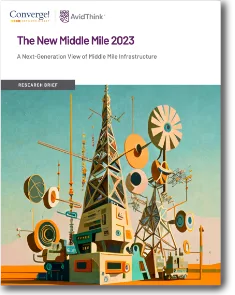
AvidThink and Converge Network Digest are pleased to present our New Middle Mile Resource site that examines the evolution of middle mile infrastructure. We discuss how the changing needs of consumer and enterprise workloads will reshape the middle mile and suggest a new definition of the middle mile. We show how the middle mile will transform into a strategic location in the end-to-end digital pipeline from edge to cloud and share the key technologies to make this happen. Check out the videos from thought leaders, and download the AvidThink report.

Looking for our latest video showcases?
ONUG Spring 2023 (Dallas) | MPLS World Congress 2023 (Paris)| 2023 MWC Showcase (Barcelona)

While you're here, check out the popular Telco Cloud and Edge Report making its rounds across leading telcos.
Analysis by AvidThink

What the 2023 New Middle Mile report finds

Across these interviews, the middle mile emerges as the strategic control point for multi-cloud connectivity, with carriers and vendors racing to make it programmable, on-demand, and API-driven while confronting fiber shortfalls and the physics of scaling core networks.

  1. Multi-cloud demand drives the renaissance

    Aarna Networks and Zayo tie middle-mile growth to enterprises using multiple public clouds, needing dedicated on-demand connectivity plus neutral sites to host state data and avoid egress costs.

  2. APIs and automation are the enabler

    PCCW Global uses MEF Sonata APIs in its Console Connect platform to automate last-mile provisioning, while AT&T leverages LSO APIs and virtual cross connects for automatic cloud provisioning.

  3. The US faces a fiber deficit

    Arelion notes Europe's 20-year-old fiber remains in good shape, while the US lacks middle-mile fibers despite strong last-mile fiber-to-the-home growth.

  4. Core networks confront a physics upgrade

    BT weighs putting coherent WDM optics directly into routers versus keeping transponders to support 400 gigabit and beyond, while NTT shifts from electronics to photonics to cut power and latency.

  5. Unified fabrics stitch cloud to edge

    Arrcus Connected Edge and FlexMCN, plus Graphiant's stateless core carrying metadata in the data plane, aim to deliver secure any-to-any mesh connectivity with guaranteed SLAs.

  6. Carriers reinvent as digital platforms

    Colt shifts to on-demand generation-based connectivity, Orange transforms its backbone to serve 220 geographies co-located with cloud providers, and Tata's MOVE connects IoT and consumer assets at scale.

Download the full report →

Highlights from industry thought leaders

Video interviews

Aarna Network

New Middle Mile: How is it Changing the Game for Multi-Cloud Networking?

  • Aarna Networks ties the middle-mile renaissance to enterprises needing on-demand, self-service links to multiple public clouds.
  • Cloud repatriation makes the middle mile an ideal neutral site to host state data and avoid egress costs.
  • Orchestrating tens of infrastructure vendors and hundreds of services across thousands of sites is a core challenge.
Abstract
In this video, Amar Kapadia, CEO of Aarna Networks, explains why the middle mile is going through a renaissance and how it is changing the game for multi-cloud networking. He discusses three factors driving the anticipated growth of the middle mile: * Multi-cloud networking: Enterprises are choosing to use multiple public clouds to run their business, and they need dedicated connectivity to each of these clouds. This connectivity has to be provided on demand in a self-service manner. * Cloud repatriation: To use multiple clouds effectively, the state information or the data has to be moved to a neutral site that can be accessed by any public cloud or even private clouds in an easy-to-use manner without incurring egress costs. The middle mile is an excellent location to host the storage or the databases for the state information. * Orchestration: It requires orchestration of tens of heterogeneous infrastructure vendors across tens of thousands of sites, following that it requires orchestration of hundreds of Network Services and applications across this infrastructure. Watch this video to learn more about how the middle mile is changing the game for multi-cloud networking.
Arelion

New Middle Mile: Why is the US Lacking Middle Mile Fibers?

  • Arelion notes Europe's 20-year-old fiber remains in good shape, easing middle-mile equipment upgrades.
  • The US has significant missing middle-mile fiber from years of under-deployment, despite strong last-mile growth.
Abstract
In this video, Mattias Fridström, Chief Evangelist from Arelion, explains why the US is lacking middle mile fibers. He highlights three key talking points: * Europe has a lot of fibers built 20 years ago that are still in good shape, making it easier to equip the middle mile with more equipment. * In contrast, the US has a significant amount of missing fibers in the middle mile due to a lack of fiber deployments over the years. * While there is fantastic growth in last mile fibers being built to the home in the US, there is a need for more middle mile fibers to be built. If you're interested in learning more about the challenges of building middle mile fibers in the US, this video is a must-watch.
Arrcus

New Middle Mile: Achieving a Unified Network in Distributed Cloud: Solutions for CSPs.

  • Arrcus Connected Edge (ACE) stitches edge workloads into the multi-cloud for communication service providers.
  • Arrcus FlexMCN provides a secure multi-cloud fabric with control, visibility, and guaranteed SLAs.
Abstract
Sanjay Kumar, VP Product Management and Marketing from Arrcus, explains why communication service providers need a unified network like Arrcus Connected Edge (ACE) that stitches together workloads from the edge into the multi-cloud. In addition, Sanjay touches on: * The need for control, visibility, and guaranteed SLAs for applications * Arrcus FlexMCN, a solution for multi-cloud, and how it provides a secure fabric from cloud to edge
AT&T

New Middle Mile: How Does AT&T Deliver End-to-End Circuit Quality?

  • AT&T uses LSO APIs to integrate partners, vendors, and competitors for end-to-end circuit quality.
  • AT&T's Business Center lets customers create a virtual cross connect in any participating cloud provider.
Abstract
Jeremiah Ginn, Cybersecurity Evangelist from AT&T, explains how they deliver end-to-end circuit quality through their defined core, leveraging LSO APIs to integrate with partners, vendors, and competitors, and their solution that allows for automatic provisioning of connections to different cloud service providers. AT&T's Business Center also gives customers the ability to create a virtual cross connect in any participating cloud service provider through orchestration in the API.
BT

New Middle Mile: How Will BT Upgrade Their Core Network?

  • Coherent WDM transceivers now fit in a pluggable connected directly to a router, replacing transponder cards.
  • BT weighs keeping transponders versus putting WDM optics in routers hop-by-hop to support 400 gigabit and beyond.
  • The best option depends on bandwidth and distance; BT plans to trial all options before choosing.
Abstract
How will BT upgrade their core network to support 400 gigabits and beyond? In this video, Russell Davey, Distinguished Engineer and Principal Network Architect from BT, explains the different options they are considering. Here are the top three talking points from the video: * With the advancement of coherent WM transceivers, it's now possible to put them in a plug that can be directly connected to a router, instead of using a separate transponder card. * BT is considering two options for upgrading their core network: continuing to use rodems and transponders, or putting the WDM optics into the router and going hop by hop through all the routers down the length of the country. * The best option for a particular route will depend on bandwidth and distance, and BT plans to deploy all the options over the next year or so before picking the best one. Overall, the video provides valuable insights into how BT plans to upgrade their core network to support faster speeds and stay ahead of the curve.
Colt

New Middle Mile: How Colt is Enabling Digital Transformation

  • Colt is evolving from traditional connectivity to an on-demand, generation-based model enabling flexibility.
  • Colt is pursuing digital-transformation use cases across manufacturing, healthcare, and other industries.
Abstract
How is Colt enabling digital transformation? Mirko Voltolini, VP Innovation from Colt, explains why: * Colt is building products for the future of digital infrastructure to connect businesses in real-time. * Colt is evolving from traditional connectivity to an on-demand, generation-based model that enables change and flexibility. * Colt is working on a number of use cases to enable digital transformation in various industries, including manufacturing, healthcare, and more. Watch this video to learn more about how Colt is enabling digital transformation through its new middle mile approach.
Graphiant

New Middle Mile: Graphiant Enables CSPs to Provide Mesh Connectivity for Enterprises

  • Graphiant helps CSPs unlock the value of their connectivity assets for enterprise customers.
  • Graphiant enables any-to-any mesh connectivity with desired SLAs, without complex overlays.
Abstract
Khalid Raza, CEO of Graphiant, explains how their innovative solution can help CSPs unlock the value of their connectivity assets. By partnering with Graphiant, CSPs can help the enterprise customers: - Tackle the disaggregation of data and adapt to a mesh topology environment - Connect anyone to anyone, anywhere to anywhere without complex overlays and with desired SLAs
Graphiant

New Middle Mile: How does Graphiant overcome network inflexibility?

  • Graphiant's stateless core keeps transit as pure transport, fast and flexible versus rigid topologies.
  • Graphiant puts metadata into the data plane so traffic routes freely without complex customer configuration.
  • Graphiant's service is designed to become an open standard shared with the industry.
Abstract
Ali Shaikh, Chief Product Officer from Graphiant, explains how their network architecture delivers a simple network service. Key takeaways: * Graphiant's stateless core philosophy ensures that the transit is pure transport, fast and flexible, instead of today’s inflexible and rigid topologies * Graphiant's architecture puts metadata into the data plane itself, allowing customer traffic to go wherever it needs to without having to worry about how to manage a complicated customer configuration landscape * Graphiant's service is built in such a way that it can become an open standard and shared with the industry
InsidePacket

New Middle Mile: How can Service Providers Improve their Network to Meet New Workload Demands

  • InsidePacket's network-as-a-service lets providers automate existing infrastructure on commodity hardware to cut costs.
  • Providers can add services and application observability, connecting enterprise customers to assets anywhere.
  • InsidePacket focuses on the middle mile as where providers can become the center of the enterprise offering.
Abstract
In this video, Eli Karpilovski, CEO, InsidePacket, explain discusses how his company's network-as-a-service solution can help service providers automate their networks, reduce costs, and deliver new services to enterprise customers. Here are the top three talking points: - Inside Packet's solution enables service providers to take their existing infrastructure and automate it, providing a reduction of cost by running on commodity off-the-shelf hardware. - Service providers can add services on top of their network infrastructure, connecting enterprise customers to all their assets wherever they are and providing application observability tools that are missing from their current offering. - InsidePacket is focused on the "middle mile," where service providers have the biggest potential to become the center of the offering for enterprise customers, connecting them to clouds and providing new revenue streams.
NTT

New Middle Mile: Is Today's Infrastructure Sufficient for the Next Internet?

  • NTT says today's infrastructure cannot support the next internet of 3D animations, virtual worlds, AI, and holograms.
  • NTT is shifting from electronics to photonics to reduce power consumption and latency for future infrastructure.
Abstract
Are you wondering if today's infrastructure is enough to support the next internet? In this video, Vito Mabruco, Global CMO from NTT, explains why the answer is no and what we need for the next internet. Here are the top three talking points from the video: * Today's infrastructure is not enough to support the next internet, which will require more capacity for 3D animations, virtual worlds, AI, and holograms. * NTT is addressing the need for the next infrastructure by changing the paradigm from electronics to photonics, which they have been using for long-distance transmission and telecommunications. * By replacing electronics with photonics, NTT can reduce power consumption and latency, which will be crucial for delivering the infrastructure of the future. Watch the video to learn more about NTT's vision for building the next infrastructure based on photonics.
Orange Business

New Middle Mile: How Orange is Delivering Cloud-Based Services to 220 Geographies?

  • Orange is transforming its backbone into a full internet backbone delivering cloud services in 220 geographies.
  • The backbone is co-located with Google, Azure, and AWS, federating resources via APIs and orchestration.
  • Orange hosts SaaS vendors on its Evolution platform to ensure an end-to-end digital experience.
Abstract
Franck Morales, VP Evolution Platform from Orange, explains how they are delivering a secure digital infrastructure to accompany their customers in their digital-first business. Orange is transforming its backbone into a full internet backbone to deliver cloud-based services in 220 geographies. The backbone is fully co-located with major cloud providers like Google, Azure, and AWS. Orange is also clarifying the use case of SaaS and ensuring an end-to-end answer to customers by doing a Federation of resources using API and orchestrations. This simplifies the design and management of solutions and ensures a digital experience. Orange is hosting SaaS solution vendors that will be delivered from their infrastructure within Evolution platform, ensuring an amazing and outstanding digital experience while continuing to benefit from the innovation of technology vendors.
PCCW

New Middle Mile: How Can APIs Help Automate Connectivity Services?

  • PCCW Global says extending connectivity beyond data centers to buildings requires downstream partner APIs.
  • PCCW uses MEF Sonata Automation APIs in its Console Connect platform to automate downstream provisioning.
Abstract
Divesh Gupta, VP of New Technology & Sales Operations at PCCW Global, explains how APIs can help automate the extension of connectivity services from the middle mile to the last mile. Here are the top talking points from the video: * Automated networks are mostly limited to data center-to-data center automation, but extending connectivity services to enterprise buildings requires relying on downstream partners. * To automate the extension of connectivity services, APIs are needed to order and provision services on the fly. * MEF has released APIs under the MEF Sonata Automation, which allows service providers to automate the address provisioning product order qualification code and orders while using standard-based APIs. PCCW Global is making use of this automation capability and incorporating it into their Console Connect platform to extend their automation capability down to the downstream vendors.
Tata Communications

New Middle Mile: How Can Enterprises Connect All Their Assets Anytime, Anywhere, and at Scale?

  • Tata Communications' MOVE is a context-aware platform connecting IoT and consumer assets anytime, anywhere, at scale.
  • MOVE delivers always-on connectivity for connected cars, saving manufacturers millions and improving driver experience.
  • MOVE is pre-connected with 700 million routes worldwide, giving MVNOs global always-on connectivity and QoS insights.
Abstract
Avneesh Prakash, VP of Mobility from Tata Communications, explains how their platform, MOVE, can help enterprises connect all their assets, whether they are IoT or consumer assets, anytime, anywhere, and at scale. In this hyper-connectivity world, the whole environment is being driven by increasingly complex devices, and the key challenge that enterprises face is that their devices have to be always connected. Here are the top three talking points from the video: * MOVE is a highly intelligent context-aware connectivity management platform that enables enterprises to connect all their assets, whether they are IoT or consumer assets, to get connected anytime, anywhere, and at scale. * MOVE delivers an always-on, always-connected experience and an always-updated connected car, which saves millions of dollars for the manufacturer and gives superlative driver experience. * MOVE's platform is pre-connected with 700 mm routes around the world, which gives MVNOs an always-on, always-connected global connectivity experience. They also have access and insights into some very unique data elements, such as quality of service, which they use to drive end-user or an enterprise business use cases.
Zayo

New Middle Mile: Hyperscaler and cloud trends drive metro fiber upgrades

  • Zayo says hyperscaler and multi-cloud trends drive middle-mile fiber adoption by enterprises and government agencies.
  • Zayo highlights the importance of APIs and agile service management in metro fiber upgrades.
Abstract
Jason Taylor, VP of Large Enterprise Sales at Zayo discusses the role hyperscaler trends and multi-cloud use drives fiber adoption and upgrades in the middle mile by enterprises and government agencies. He also touches on the importance of APIs and agile service management.
By adopting a more flexible architecture across all layers, from physical to network to application, the new middle mile can provide flexible and resilient connectivity, better accommodate the diverse requirements of modern workloads, and deliver a superior end-user experience. — 2023 New Middle Mile Report
Download the Full Report

By downloading this report, you agree to our Terms of Use and Privacy Policy.