

Marvell executives discuss the evolving infrastructure requirements for AI and cloud computing at the hyperscale level. Will Chu, SVP and GM, Custom Cloud Solutions Business Unit; Radha Nagarajan, SVP and CTO, Optical and Cloud; Xi Wang, SVP and GM, Connectivity; Rishi Chugh, VP and GM, Data Center Switching; Matt Kim, AVP, Custom Cloud Solutions Business Unit; and Annie Liao, Product Management Director examine how hyperscalers are moving beyond XPU customization to reimagine entire system trays, including memory, storage, security, and networking components.
Marvell Industry Analyst Day Showcase
Welcome to Marvell Industry Analyst Day Showcase! The event was held at Marvell's Corporate Headquarters in Santa Clara, California on December 9, 2025. The NextGenInfra team was onsite for the event, capturing video interviews with Marvell's executives.
Meanwhile, download the 2025 edition of our AI in Networking Report, covering the role of AI in network operations. We're also working on the update to our data center networking report for release in Jan 2026 (stay tuned). And yes, we will cover Marvell in that report, along with other leading vendors in data center networking. Drop us a line if you want to be included at research@avidthink.com.
Meanwhile, download the 2025 edition of our AI in Networking Report, covering the role of AI in network operations. We're also working on the update to our data center networking report for release in Jan 2026 (stay tuned). And yes, we will cover Marvell in that report, along with other leading vendors in data center networking. Drop us a line if you want to be included at research@avidthink.com.
Highlights from Marvell Execs at Industry Analyst Day


Reader feedback on AI in Networking 2025 — Harnessing the AI Deluge: “well-written,” “tracks the cutting edge in AI,” “thoughtful.” Grab your copy now and give it a read today!
Interviews with Marvell Executives at Industry Analyst Day
The following media comprises interviews and other content related to Marvell's Industry Analyst Day 2025. Views expressed are those of the presenting individuals and companies and may not necessarily represent views of Converge! Network Digest or AvidThink. Marvell is a sponsor of NextGenInfra.io
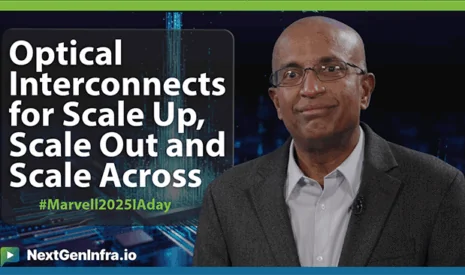
Optical Interconnects for Scale Up, Scale Out, Scale Across
Radha Nagarajan, SVP and CTO, Optical and Cloud, outlines three networking architecture categories and how Marvell addresses all three segments through its Celestial acquisition for scale up, internal development for scale out, and an established business in scale across, including 1.6 terabit per second single wavelength links currently in development.
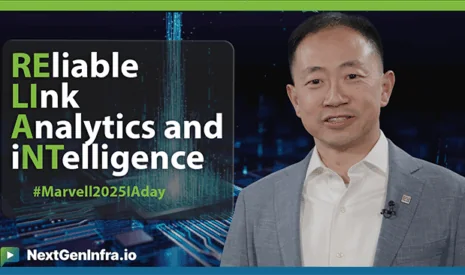
Marvell's RELIANT Software & Golden Cable
Xi Wang, SVP and GM for Connectivity, introduces the company’s RELIANT software suite and Golden Cable program designed to remotely monitor and manage AI infrastructure connecting hundreds of thousands of GPUs and XPUs by collecting data from DSPs in cables and optical modules.
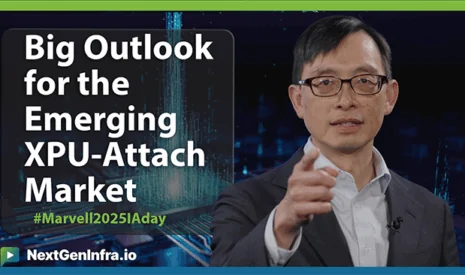
Custom XPU Solutions: Memory, Security & Networking
Will Chu, SVP and GM, Custom Cloud Solutions BU, discusses the company’s expansion into XPU attach solutions, where Marvell customizes all components within the XPU tray, including CXL-enabled memory for expansion and near-memory compute, security devices for AI infrastructure management, and high-performance NICs.
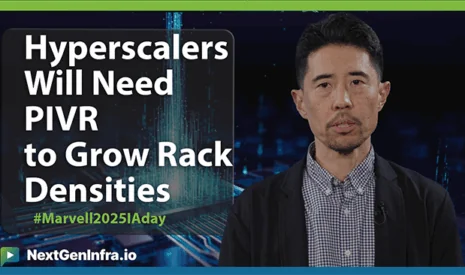
Solving Multi-Kilowatt AI Chip Power Delivery
Matt Kim, AVP, Custom Cloud Solutions Business Unit, presents PIVR (Package Integrated Voltage Regulator) technology as a solution to power delivery challenges in the multi-kilowatt chip era where moving voltage regulators directly into the XPU package increases current density performance by up to 2x and reduces power transmission losses by as much as 85%.
PCIe Evolution: From 5.0 Retimers to 8.0 Optical Solutions for AI
Annie Liao, Product Management Director outlines Marvell’s PCIe retimer product roadmap from generations 5.0 through 8.0, explaining how current electrical solutions will face increasing challenges at higher data rates of 128 and 256 Gbps per lane. She describes their strategic development of optical PCIe solutions, including partnerships for optical modules and cables as well as in-house co-packaged optics (CPO) technology.
SNEAK PEAK on How AI Reshapes Data Center Networks
Rishi Chugh, VP and GM, Data Center Switching at Marvell, joins Roy Chua, Principal and Founder of AvidThink, to explore how AI workloads are fundamentally changing data center networking by demanding flatter architectures and unprecedented levels of reliability. The discussion covers how AI training’s massive power consumption and time requirements make network failures extremely costly, driving the industry to reconsider traditional Ethernet approaches and adopt more complex designs with distinct front-end and backend networks.