

2026 Predictions Showcase
Also, we're featuring our recently launched 2026 report on Enterprise Connectivity where we cover the latest trends in SASE, SSE, SD-WAN, and campus networking. Download your copy today! (ungated)
2026 Predictions from Thought Leaders in Infrastructure Technology
















Early feedback on New Faces of Enterprise Connectivity Report: “very comprehensive,” “covers cutting-edge trends in the enterprise networking market,” “insightful.” Grab your copy now!
2026 Predictions from AI, Networking, Cloud, Security, and Mobile Thought Leaders
Views and predictions expressed are those of the presenting individuals and companies and may not necessarily represent views of Converge! Network Digest or AvidThink.

AI, Security & New Revenue Opportunities
Stephan Rettenberger, SVP of Marketing and Corporate Communications at Adtran discusses AI’s continued industry dominance constrained by power consumption; digital sovereignty and security advances including post-quantum cryptography; and service providers evolving beyond infrastructure into digital platforms.
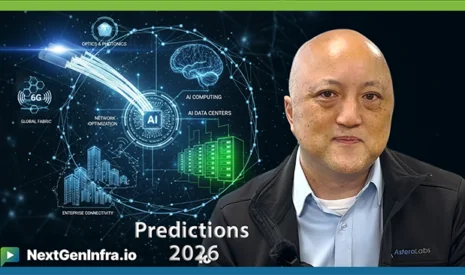
Specialized Accelerators, Hybrid Fabrics & Tiered Memory
Thad Omura, Chief Business Officer at Astera Labs, expects adaptability and flexibility through specialized accelerators, hybrid AI fabric solutions combining multiple protocols, and tiered memory architectures for large-scale inference workloads to be front and center in 2026.
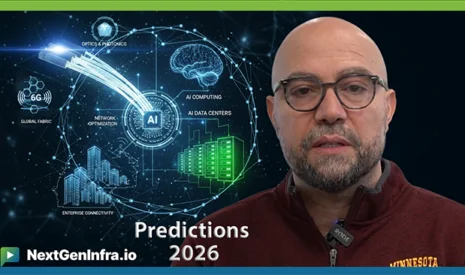
5 Fiber Industry Trends Shaping 2026
Anis Khemakhem, Chief Marketing Officer at Clearfield, identifies five major trends shaping the fiber industry, including accelerated global fiber deployment driven by BEAD funding and public-private partnerships, the growing importance of simplified design and training to address workforce shortages, and speed and density innovations through higher-capacity hardware and multi-gigabit technologies.

Inference, Neoclouds & Reliability Challenges
Don Barnetson, SVP & Head of Product at Credo, talks about “the year of inference” as AI shifts from training to decode-heavy applications requiring significantly more memory capacity, while AI spending moves from traditional hyperscalers to neoclouds that need vendor support for rapid deployment.

GPUs diversity and Ethernet in Scale-Up
Dudy Cohen, VP of Product Marketing at DriveNets, presents three predictions for 2026 AI infrastructure: a more heterogeneous GPU market, networking becoming a critical design consideration, and Ethernet emerging as the leading technology across all AI infrastructure connections (from scale-up to scale-out).

Ethernet's Path to AI Dominance
Peter Jones, Chair of the Ethernet Alliance and Cisco Systems employee, presents predictions for Ethernet in AI applications, expressing confidence that Ethernet will succeed despite uncertainty about the specific path forward. He emphasizes that while the exact methods remain unclear, the industry understands its objectives and will determine the necessary approaches to meet customer needs.

Fiber Growth, Quantum & AI Infrastructure
Gary Bolton, President and CEO of the Fiber Broadband Association, predicts that 2026 will see record fiber deployment driven by private investment and BEAD program funding, while quantum networking becomes critical as “Q Day” threats accelerate the need for enhanced encryption security.

AI Bubble Correction in 2026: Network Infrastructure's Critical Role
Ali Shaikh, Chief Executive Officer of Graphiant, expects a significant correction in the AI bubble as rapid model scaling and data center expansion reach a plateau, shifting focus toward actual business value and real-world applications. He shares how this will impact networking in 2026.
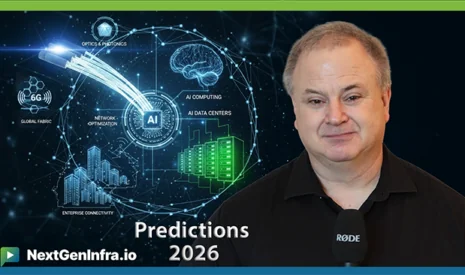
The Future of Ethernet: 200G to 3.2T and Beyond
John D’Ambrosia, Chair of the IEEE P802.3dj Task Force at IEEE, discusses the future of Ethernet, focusing on the completion of the 802.3dj standard introducing 200 Gbps signaling for speeds up to 1.6 terabit Ethernet, with products already shipping. He highlights the industry’s move toward defining 400 Gps signaling as the foundation for next-generation speeds including 3.2Tbps Ethernet and beyond.

AI CPU Deployments, Edge Computing & 6G
Cristina Rodriguez, VP and GM of Network & Edge Group at Intel, forecasts widespread AI deployments using CPU native capabilities for radio algorithms and infrastructure optimization, enterprise adoption of on-premises edge computing with multi-tenancy support, and intensive industry focus on defining 6G standards and monetization strategies.
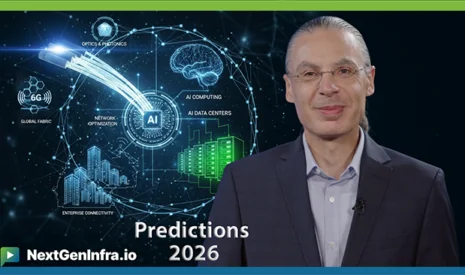
Optical Networks, AI Chip Design & Memory Architecture
Noam Mizrahi, EVP and Corporate CTO at Marvell, presents three key predictions for the semiconductor and AI infrastructure landscape in the coming year. He anticipates hybrid electrical-optical connectivity evolving to fully optical by 2027, greater integration of AI capabilities into chip design technologies, and expanded memory capacity beyond traditional HBM through attached or disaggregated architectures.

OIF on 448G, Coherent Lite, CMIS & Power Efficiency
Nathan Tracy, President of OIF, discusses 2026 predictions focusing on the industry’s push toward 400/448 Gbps implementation while addressing reliability, power efficiency, and reach challenges, with particular emphasis on coherent lite market development and CMIS as critical firmware infrastructure for AI applications.
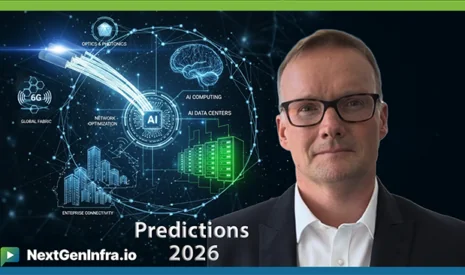
5G Advanced, Telco AI, Satellite-to-Device & 6G
Stephen Douglas, Head of Market Strategy at Spirent, talks about 5G Advanced momentum with RedCap IoT and location services, telco AI offerings like GPU-as-a-service, and expanded non-terrestrial direct-to-device capabilities beyond emergency use cases. He also discusses accelerated 6G standardization focused on new spectrum bands, integrated sensing, and cybersecurity.

AI Data Centers, Quantum Security & Sensing Convergence
Sameh Yamany, CTO & Chief AI Officer at VIAVI, discusses convergence of networks, security, AI, photonics, and sensing that will fundamentally change how the industry designs, deploys, and tests infrastructure. He forecasts how high speed data center networking, AI-enabled cybersecurity threats, and use of AI in RAN will have implications on testing needs this coming year.

3 Predictions for Enterprise AI and Infrastructure in 2026
James Tomko, SVP of Sales at Zayo, predicts that enterprise AI adoption will enter an expansion phase in 2026 with increased ROI evaluations and operational integration, while the Neocloud vertical will see market separation between successful and struggling companies amid capital intensity challenges.
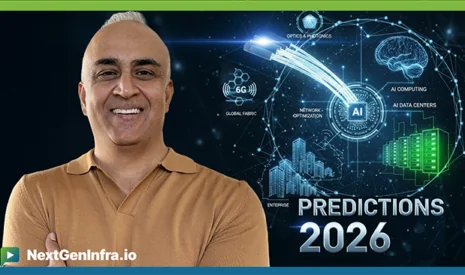
Ethernet Dominance, Multi-Site Clusters & Co-Packaged Optics
Hasan Siraj, Head of Software Products/Ecosystem at Broadcom, presents three networking predictions for 2026 centered on AI infrastructure, including Ethernet becoming the standard for scale-up networking, AI clusters expanding across multiple data centers with Ethernet as the interconnecting fabric, and co-packaged optics going mainstream due to 70% power efficiency gains. Broadcom is investing heavily in these technologies while collaborating with customers and partners to enable these infrastructure transitions.
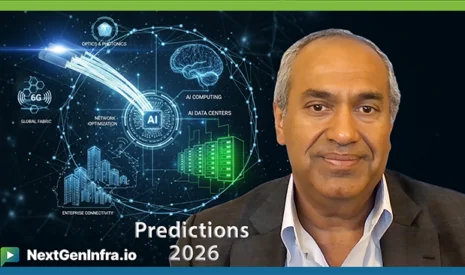
AI Infrastructure, Bandwidth, Timing & Robotics
Piyush Sevalia, Executive Vice President, Marketing at SiTime, presents three key predictions for 2026 focused on AI infrastructure’s demand for resilient timing solutions, the transition from 800G to 1.6 terabits per second networking bandwidth, and AI-enabled robotics requiring precision timing under extreme conditions. He explains that keeping expensive GPUs running continuously, accelerating data delivery, and enabling robots to operate in challenging environments where humans cannot are driving significant design activity for SiTime’s timing technology.

Data Center Power, Water & AI Infrastructure Trends
Jenn Cahill, Assistant VP of Campus Infrastructure Integration at Black & Veatch, projects that 2026 will bring increased partnerships between power suppliers and data center developers, with collocated generation and sustainable options like SMRs becoming more prevalent, alongside significant water management innovation driven by GPU cooling demands in warmer regions. She highlights the rise of neocloud providers offering distributed AI-as-a-service in the 20-80 megawatt range, and emphasizes that data-driven decision-making through integrated campus simulations and AI-enabled operations will become standard practice across the industry.

Cellular, Sovereign Cloud & Supply Chain Issues
Archana Khetan, SVP, Product Management and Technical Marketing at Ericsson, presents three key predictions for 2026: cellular technology becomes a viable alternative to wired connections as customers actively consider it due to technological advancements and financial viability; geopolitical factors drive adoption of sovereign and private cloud solutions for security and autonomy; and DDR4 memory shortages impact network product lifecycles across the industry.

Telecom's Shift from Automation to Autonomy
John McVey, Global VP of Customer Success at Blue Planet (a Ciena Company), presents three key predictions for how the telecom industry shifts from automation to autonomy in 2026, including the critical need for accurate OSS data as a prerequisite for agentic AI, the advancement of autonomous network use cases from pilots to production environments, and the acceleration of legacy OSS decommissioning as CSPs retire decades-old mainframe systems that block AI capabilities. McVey emphasizes that winning networks in 2026 will be smarter, self-governing systems built to operate at machine speed as Blue Planet helps CSPs modernize their OSS environments to unlock measurable autonomy.