

OCP Global Summit Showcase
OCP's mission is unchanged: taking hyperscale innovation to all, guided by openness, efficiency, sustainability, impact, and scale. What's growing is the scope — from the data hall to the full AI infrastructure stack, spanning silicon diversity, chiplets, facilities, energy, and the AI computing continuum from hyperscale data centers to regional and smaller sites. Looking to 2027 and beyond, OCP is launching three initiatives: system technology co-optimization for silicon design, modular interfaces that reduce grid-to-chip redesign, and solutions for smaller racks under 100 kilowatts.
Jim Carroll of Converge Digest and Roy Chua of AvidThink were onsite gathering video interviews with speakers, vendors, and community leaders. We appreciate our multi-year partnership with OCP and thank them for letting us capture video. We're still gathering and editing interviews from the show, and we'll post new videos here as they're ready — check back for more.
While you're here, feel free to grab our latest research brief right from this page.
Why Coherent-Lite Demand Is Taking Off
OCP 2026 Takeaways: CPO vs. NPO
Powering AI Data Centers: Two Paths from 50V to 800V
Co-Packaged Optics Demo in a Liquid-Cooled Rack
How AI Powers Outcome-Driven Networking for Enterprises
Why Ethernet Is Winning AI Networking
Making the Case for OCI
Scaling AI Across Buildings: 32x Denser Networks for Hyperscalers
New USFP Open Optical Form Factor Scales to 12.8T
d-Matrix Attention Feed-Forward Disaggregation at 800+ Tokens/Sec
Grid to Rack as One Power System
Validating Scale-Up, Scale-Out, and Scale-Across
200-Terabit Optical Switch: Collaboration Advances AI Networking
Slow and Wide Optical PCIe
Copper vs. Fiber in AI Scale-Up: Why Optics Are Moving Inside the Box
One Faulty Connection Can Stall GPU Revenue
NVIDIA's Power Efficiency Leap: CPO & 800V Racks
Efficient AI Inference at Rack Scale
Open Infrastructure, Neoclouds & Supply Chain
Why Test & Measurement Drives AI Job Performance
From LiDAR to Optical Circuit Switching
Solving the Data Center Bandwidth Bottleneck
Xsight's 200G DPU for Edge AI & Space Computing
From hyperscale to the AI computing continuum and beyond
Latest Research Brief
Download Our Latest Report
Data Center Networking in 2026 — Scaling to New Heights
More about this report →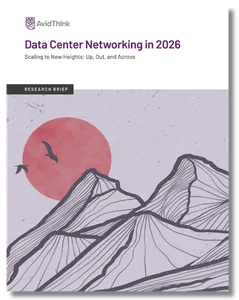
No personal info needed to download
By downloading this report, you agree to our Terms of Use and Privacy Policy.
Highlights from industry thought leaders






















Video interviews
Why Coherent-Lite Demand Is Taking Off
- Meta's day-one keynote confirmed AI clusters no longer fit in one building and now span sites 2–10 km apart.
- Those sites are linked by trenches of conduits, each carrying on the order of a thousand fiber strands.
- 650 Group raised its coherent-lite forecast for scale-across about two months before the show, and Meta's talk signals the market is taking off as projected.
Abstract
OCP 2026 Takeaways: CPO vs. NPO
- OCP 2026 was fundamentally an optics show, with heated NPO-versus-CPO debate settled by manufacturing scale and fit with XPU roadmaps.
- Laser demand is moving from hundreds of millions to billions, opening room for high-power lasers, VCSELs for scale-up and microLEDs for memory.
- Weckel expects an "all of the above" outcome, matching each technology to the workload for cost- and energy-optimized deployments.
Abstract
Powering AI Data Centers: Two Paths from 50V to 800V
- Advanced Energy supports both today's 50 V AI infrastructure and the industry's move to 800 V architectures.
- One path keeps 50 V trays and adds a rack power shelf that converts 800 V down to 50 V.
- The other brings 800 V into the tray, where a hot-swap power distribution board and onboard converters step down to 50, 12 or 6 V.
Abstract
Co-Packaged Optics Demo in a Liquid-Cooled Rack
- Ayar Labs, Wiwynn and Corning show an upgraded optical scale-up rack aimed at proving co-packaged optics can be built and delivered reliably at scale.
- It is the first live rack demo of Ayar Labs' TSMC COUPE-based optical engines, integrated with GPU and HBM in GUC multi-chip packages for more than 200 Tbps of scale-up bandwidth.
- Hours of fully liquid-cooled operation show stable micro-rings, lasers held near 50°C, and all components within their temperature ranges.
Abstract
How AI Powers Outcome-Driven Networking for Enterprises
- BE Networks positions itself as a control plane for large fabrics, edge deployments, private clouds and neoclouds.
- As hyperscaler technology flows down to enterprises, the company helps them build better networks.
- Its new outcome-driven networking moves beyond intent, using AI to deliver the result customers actually want rather than just the starting point.
Abstract
Why Ethernet Is Winning AI Networking
- The Ethernet for Scale-Up Networking work group has grown from 12 founding companies to 175 members and published its 1.0 specification.
- Five hyperscalers now use Ethernet for scale-up, with at least 10 ODMs building scale-up Ethernet racks.
- Tomahawk 6 is in volume production, joined by the Thor Ultra NIC (UEC- and MRC-compliant) and the Jericho 4-based scale-across portfolio.
Abstract
Making the Case for OCI
- Meta reports 225 million hours of operation on Broadcom's Tomahawk 5 CPO platform, and the Tomahawk 6 Davidson CPO platform is expected in production next year.
- The OCI MSA — founded by Microsoft, Meta, OpenAI, AMD, Nvidia, and Broadcom — standardizes optics for scale-up by decoupling electronics from optics.
- Its DWDM-on-a-CWDM-grid approach uses standard lasers rather than comb lasers, and the MSA plans to open to more members soon.
Abstract
Scaling AI Across Buildings: 32x Denser Networks for Hyperscalers
- Hyperscalers spreading AI clusters across buildings need massive scale-across capacity, which Ciena serves with coherent transceivers and new photonic line systems.
- The RLS terminal shelf, deployed in volume for single-span links, pairs 800G coherent pluggables across C and L bands with EDFA/Raman amplification and optical protection.
- RLS Hyper Rail supports 16 fiber pairs per system – up to 32x the density and 128 fiber pairs per rack – so hundreds of fibers share one amplifier hut.
Abstract
New USFP Open Optical Form Factor Scales to 12.8T
- USFP is a new open-standard optical module with 16 or 32 lanes at up to 400 Gbps per lane, scaling from 3.2T to 12.8T.
- It extends the OSFP model in manufacturing and field deployment, growing through faster lanes and wider widths.
- The module supports air cooling and system-level liquid cooling via a top-mounted cold plate, with no fluid fittings in the module.
Abstract
d-Matrix Attention Feed-Forward Disaggregation at 800+ Tokens/Sec
- d-Matrix announced Squadron, its cluster-scale solution, at the 2026 summit.
- A live attention feed-forward disaggregation (AFD) demo ran attention on NVIDIA H100 GPUs and experts on Corsair nodes, topping 800 tokens per second per user on a 20B-parameter model.
- Memory-bound expert workloads suit Corsair's memory-bandwidth-optimized design, enabling larger batches and keeping nodes efficiently utilized.
Abstract
Grid to Rack as One Power System
- Flex spans grid-level power through rack and board power to integrated rack and server manufacturing, so customers can treat the data center as one system.
- A new pre-manufactured, payload-agnostic AI reference platform cuts deployment times by up to 50%.
- The EPC Power acquisition converts 34.5 kV straight to 800 V DC for roughly five points of efficiency gain, with solid-state transformers adding one to two more.
Abstract
Validating Scale-Up, Scale-Out, and Scale-Across
- Scale-up brings a mix of high-speed copper and optical links plus new transports like Ethernet-based standards and UALink, all needing validation at speed.
- In scale-out Clos fabrics, congestion and incast cut GPU utilization – issues Keysight helps customers resolve in pre-deployment labs.
- AI is now about systems, not devices, so qualifying any component means emulating the entire system around it at scale.
Abstract
200-Terabit Optical Switch: Collaboration Advances AI Networking
- Lightmatter and Flex built a 1RU, 200-terabit optical switch through an OCP workstream, pairing a dense laser system and all-optical connectivity with Flex's modular fiber attach units and fiber trays.
- The work has moved from a contributed white paper to prescriptive specifications covering fiber connectors, optical loss, and other critical parameters.
- The prototype is a test vehicle for building supply-chain know-how with partners such as Senko (connectors) and JetCool (liquid cooling), and both companies invite wider participation in the OCP work group.
Abstract
Slow and Wide Optical PCIe
- Lumentum's 1060-nanometer VCSEL builds on its backside-emitting platform, already shipping in high volume for 3D sensing.
- A demo with Astera Labs and Corning extends optical PCIe Gen 5 and Gen 6 across multiple racks or rows.
- Lumentum argues a "slow and wide" approach to scale-up connectivity gives the best balance of performance and reliability.
Abstract
Copper vs. Fiber in AI Scale-Up: Why Optics Are Moving Inside the Box
- Larger AI scale-up clusters push optics into shorter parts of the channel that copper has traditionally owned, moving the fiber-versus-copper decision off the front panel.
- Near-package optics keep a pluggable, modular approach while avoiding the challenges of co-packaged optics on the substrate.
- Molex's Mirror Mezz Enhanced, Gemini and other mezzanine connectors scale from 224G toward 448G, alongside its second-source Si-Fly HD for the OpenCPX MSA.
Abstract
One Faulty Connection Can Stall GPU Revenue
- MultiLane, part of the Teradyne group, offers wafer-to-rack test aimed at reducing the risk of delayed GPU revenue.
- Every AI system element – ASIC, cartridge, cable harness, GPU and switch trays – has hundreds of connections, and one fault can stop the whole system from shipping.
- Its backplane cable cartridge tester uses an Amphenol connector to verify every GPU-to-GPU pin at a functional data rate.
Abstract
NVIDIA's Power Efficiency Leap: CPO & 800V Racks
- NVIDIA optimizes for tokens per watt, using liquid cooling and 800-volt racks to raise compute density and steer more power to GPUs.
- NVIDIA Photonics co-packaged optics is shipping, improving scale-out network power efficiency by nearly 5x and resiliency by 10x.
- Future scale-up generations will use CPO beyond the rack, while the new USFP pluggable, built with Cisco and Amphenol, carries 12.8 Tb/s in one module.
Abstract
Efficient AI Inference at Rack Scale
- Rebellions builds inference infrastructure end to end, pairing its in-house Rebel 100 accelerator with a software stack tuned for serving tokens economically.
- An open-source, no-fork software strategy lets customers keep their existing tools and models without learning new skills.
- Because inference is a rack-scale problem, most customers deploy Rebel Rack or Rebel Pod rather than individual servers.
Abstract
Open Infrastructure, Neoclouds & Supply Chain
- AI data centers are in an "IBM moment" led by a few integrated players, and OCP gives momentum to those seeking open, interoperable alternatives.
- Robohn's top short-term wish is better delivery timelines, backed by more US silicon production and manufacturing capacity.
- Neoclouds are not monolithic – large providers like CoreWeave and Crusoe face different multi-tenancy networking needs than smaller players like FarmGPU.
Abstract
Why Test & Measurement Drives AI Job Performance
- The industry is entering the steep part of the AI "hockey stick," and test and measurement is now seen as critical to scaling it.
- VIAVI covers every layer from fiber, optics and transceivers through signal integrity and protocol compliance to the AI switching fabric.
- Its portfolio spans PCIe compliance, Ethernet transceiver testers, AI workload emulation and optics manufacturing test.
Abstract
From LiDAR to Optical Circuit Switching
- Voyant is bringing seven years of dense, high-yield silicon photonic switch work from LiDAR to optical circuit switching.
- AI scale-up architectures need OCS with a very small form factor, fast switching and low cost – where Nouvel says Voyant has a head start.
- Voyant sells engines and modules to OCS vendors chasing hyperscalers, positioning it for rapid scale-up deployments expected around 2029.
Abstract
Solving the Data Center Bandwidth Bottleneck
- Xscape's multicolor laser platform generates up to 100 wavelengths from a single piece of silicon to ease the data center escape bandwidth bottleneck.
- Eagle X, its first scale-up product, carries 16 wavelengths on one fiber and has more than 300,000 device hours of reliability data.
- Falcon X, billed as the first OCI MSA-compliant pluggable laser module, is shown driving a 50G NRZ compliant link.
Abstract
Xsight's 200G DPU for Edge AI & Space Computing
- The new E1L is a 200G DPU for edge environments, built on Arm Neoverse N2 cores and compatible with the existing E-series line.
- Its small power budget lets it run agentic AI workloads at the edge by offloading the CPU in power-constrained settings.
- SpaceX deploys Xsight's X2 programmable switches on V3 satellites, where remote programmability is essential.
Abstract
By downloading this report, you agree to our Terms of Use and Privacy Policy.
Continue exploring
More executive showcases across next-gen infrastructure.
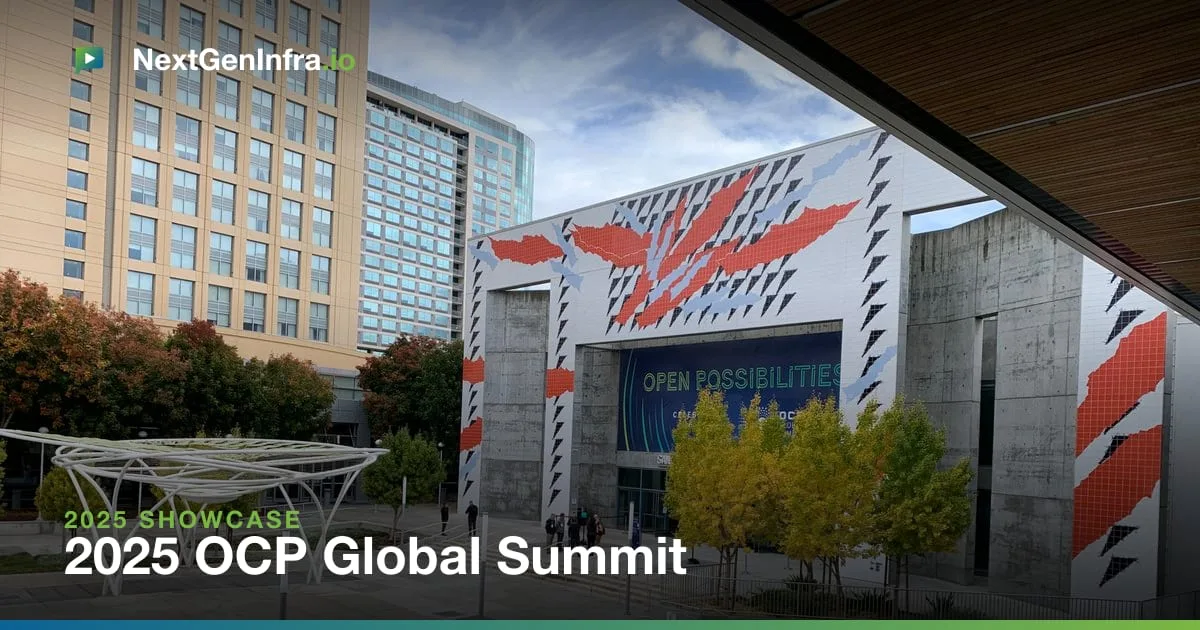
2025 OCP Global Summit
Exclusive videos from thought leaders covering data center networking (scale-up, scale-out, scale-across), photonics, liquid cooling, SONiC
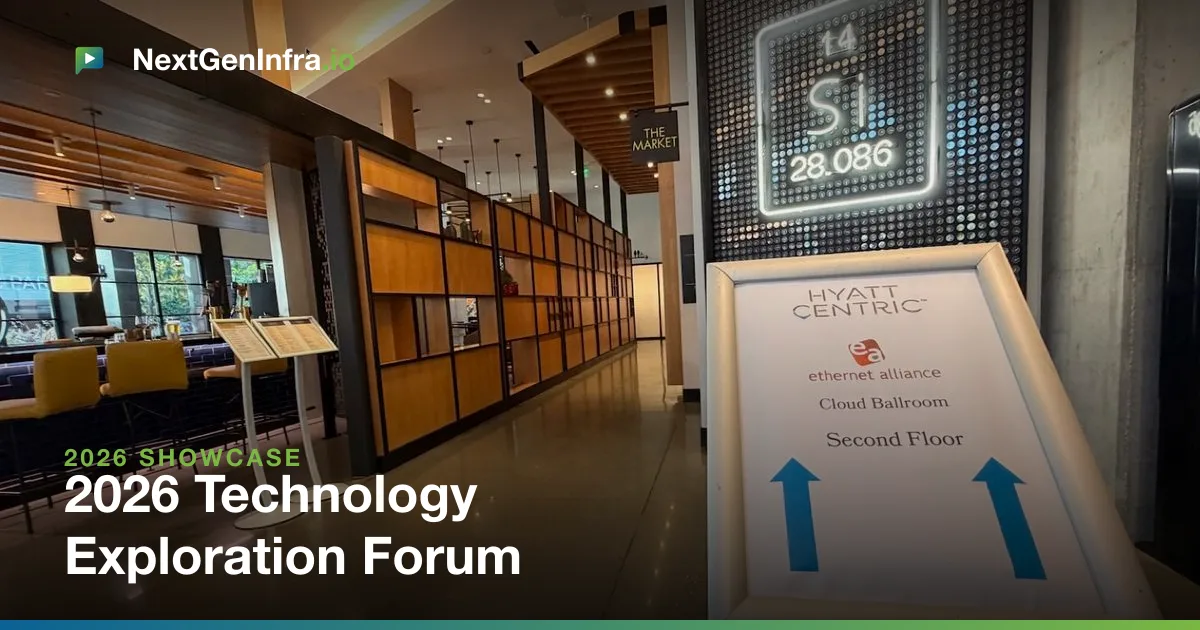
2026 Technology Exploration Forum
Highlights from Ethernet Alliance's 2026 TEF. Topics: 224/448 Gbps/lane, 1.6/3.2 Tbps, AI fabric, InfiniBand, UCIe, CXL, PCIe Gen 6/7
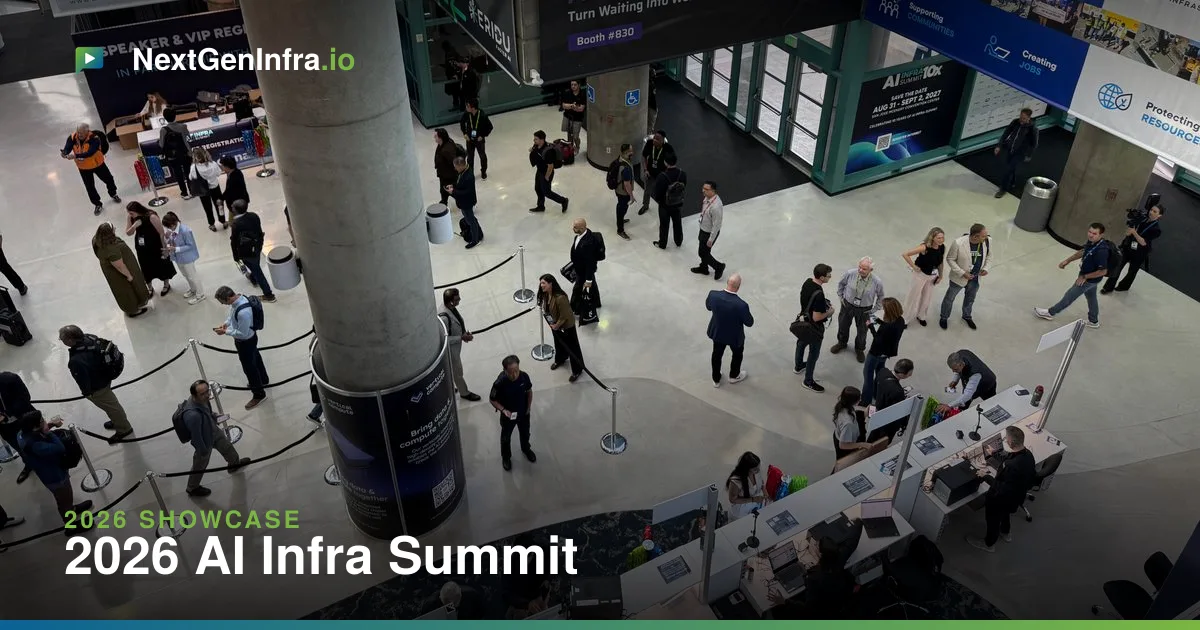
2026 AI Infra Summit
Executives at AI Infra Summit 2026 in Santa Clara discuss full-stack AI infrastructure — chips, interconnects, networking, memory, storage, power, and the data centers behind AI training and inference